Flexible cable or conventional cable? Engineering criteria for specifying conductors in industrial installations and real-world critical dynamic applications.
In an unscheduled shutdown, cable failure rarely happens by chance. It has usually been subjected to movements, bends, temperature, abrasion, or tensile stresses that were not considered in the specification. Therefore, the decision between flexible cable or conventional cable should not be limited to the price per meter or the ease of passage through the conduit. It is about making the conductor and cable construction compatible with the actual operating conditions.
In an industrial setting, the term "conventional" can create a false sense of simplicity. It's used to describe everything from cables intended for fixed installations to products with stranded construction for easier assembly. Flexibility, on the other hand, can refer to just the conductor or the entire assembly: insulation, shielding, pairs, fillers, sheathing, and mechanical behavior. The correct choice begins with separating these definitions.
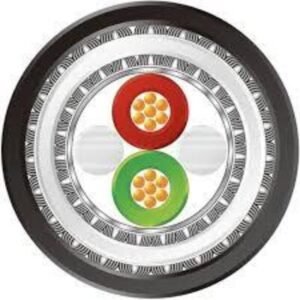
Flexible cable or conventional cable: what changes in construction?
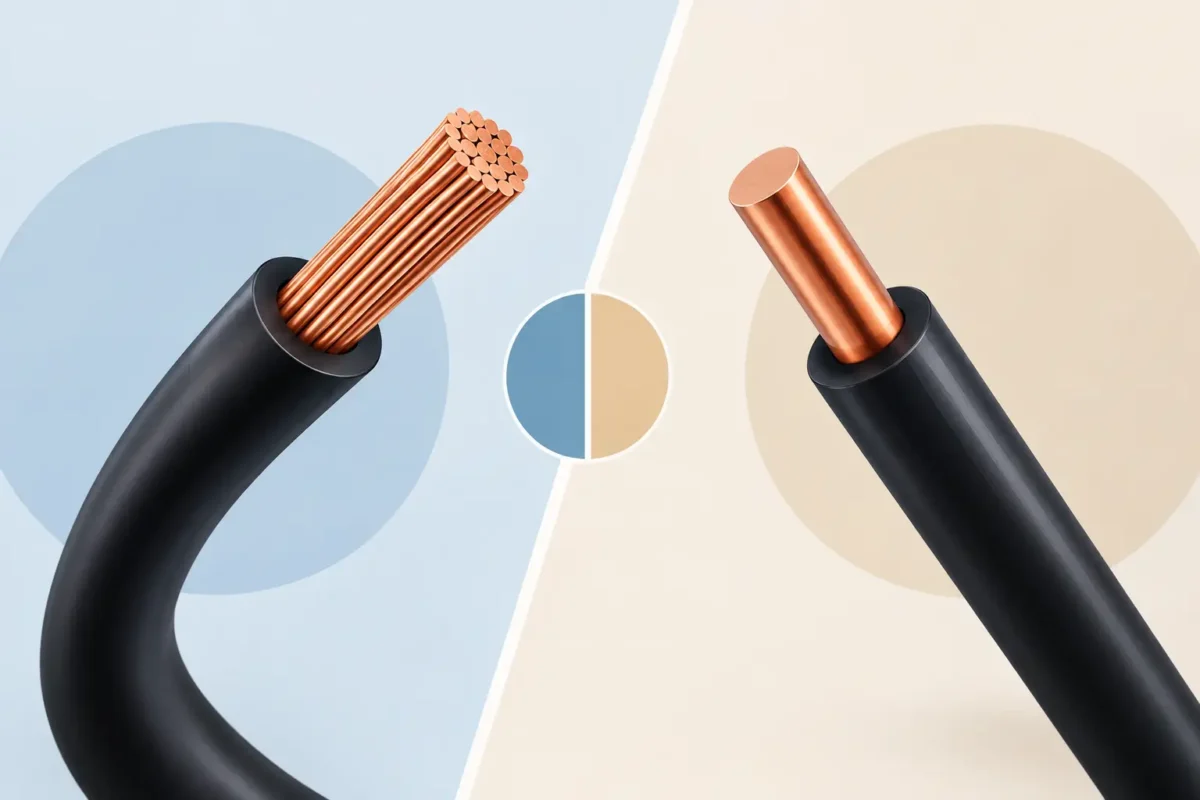
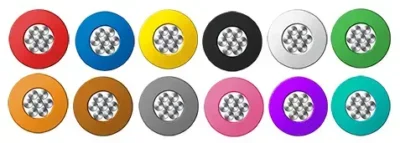
The most visible difference lies in the construction of the copper conductor. A rigid conductor can be formed by a single wire or by a few stranded wires. A flexible conductor uses a greater number of wires of smaller diameter, which allows it to accommodate bends with less stress concentration in each filament.
In standard conductor classifications, classes 1 and 2 are suitable for rigid constructions, while classes 5 and 6 are associated with flexible and extra-flexible conductors. This classification is a relevant reference, but it does not conclude the analysis. A cable with a class 5 conductor does not automatically become suitable for a cable carrier, a robot, or a continuous twisting application.
In dynamic applications, durability also depends on the strand pitch, the quality of the raw material, the internal geometry, the adhesion between layers, the resistance of the sheath, and the design for bending cycles. Cables for continuous motion are developed to control these variables. Applying a common flexible cable to a conveyor belt may work initially, but significantly increases the risk of filament breakage, insulation failure, and equipment downtime.
Conventional cable, when correctly specified for fixed installation, provides an efficient and technically adequate solution. There is no universal superiority between the two options. The choice depends on the application, the applicable standard, and the operational criticality.
Fixed installation is not a dynamic application.
The first question in the specification should be objective: will the cable remain stationary after installation or will it make repetitive movements during its service life? This answer changes the selection logic.
In electrical switchboards, panels, industrial building infrastructure, feeders, and circuits permanently housed in cable trays, conduits, or raceways, a cable for fixed installation may be the most rational choice. In this scenario, flexibility is useful mainly for laying, housing, and assembly, not for withstanding millions of bending cycles.
In machines with moving heads, overhead cranes, gantries, lifting systems, cutting tables, mining equipment, manipulators, and automated lines, movement is part of the working condition. The cable must be evaluated according to the type of stress: alternating bending, bending on a track, torsion, tension, winding on a drum, or a combination of these stresses.
A critical difference lies in the bending radius. Forcing a cable beyond the minimum recommended radius increases stress on conductors, shields, and insulation. In a fixed installation, this condition can cause damage during assembly. In a dynamic application, it repeats with each cycle and accelerates failure. The radius should be defined based on the selected cable and the available mechanical path, and not adjusted afterward to "make it fit" the product.
Flexible for assembly doesn't mean flexible for the track.
It is common to find control cables with flexible conductors in panels and machines. They facilitate connection and internal organization, but may not have the necessary construction for a cable carrier. A cable carrier imposes constant flexing in a defined plane, in addition to possible friction between cables, accelerations, decelerations, and long travel distances.
For this condition, parameters such as travel, speed, acceleration, expected number of cycles, conveyor belt radius, internal space occupied, and separation between power, control, and data cables must be verified. Cables designed for conveyor belts have specific construction characteristics to maintain geometric stability and electrical performance throughout the movement.
The same caution applies to robotics. In a robot, torsion can be as severe as bending. Cables for continuous torsion need to withstand defined angles per meter and high repeatability, without loss of integrity of the internal elements. A product suitable for linear bending is not necessarily suitable for torsion.
Electrical criteria beyond flexibility
The choice between flexible and conventional cable should not ignore electrical requirements. For the same nominal cross-section and conductor material, the current-carrying capacity depends on the installation method, ambient temperature, grouping, number of loaded circuits, and the thermal characteristics of the insulating material. The cross-section cannot be defined solely by the nominal load current.
It is also necessary to check voltage drop, short-circuit current, insulation voltage, thermal class, and system compatibility. In signal and instrumentation circuits, the concern extends to capacitance, electrical resistance, twisted pairs, individual or collective shielding, and immunity to electromagnetic interference.
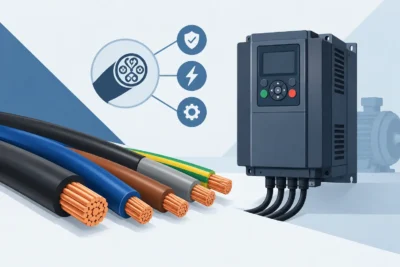
In frequency inverters and servomotors, for example, the cable is exposed to high-frequency pulses and high dv/dt values. The specification may require appropriate insulation, efficient shielding, and a compatible grounding solution to reduce emissions, induced currents, and impacts on the system. In this case, deciding only between "flexible" and "conventional" oversimplifies an engineering problem.
Terminations also require attention. Flexible conductors must receive compatible preparation and accessories, such as appropriate terminals and, when applicable, ferrules. Incorrect compression can cut filaments, increase contact resistance, and generate localized heating. The quality of the connection is part of the overall reliability of the assembly.
How to choose the right cable for each project.
A consistent specification brings together operational, installation, and environmental information before defining the product. In critical industrial applications, it is worthwhile to structure the decision based on four areas:
- Mechanical regime: Fixed installation, occasional bending, conveyor belt, twisting, winding, traction, and expected number of cycles.
- Electrical condition: voltage, current, cross-section, voltage drop, short circuit, signal type, interference control, and grounding.
- Operating environment: Temperature, humidity, oil, grease, chemicals, UV, ozone, salinity, flame, abrasion, and mechanical impact.
- Compliance and documentation: Project standards, industry requirements, certificates, traceability, identification, and test reports when necessary.
These criteria prevent two common mistakes. The first is unnecessarily oversizing the solution, increasing costs and making installation more difficult. The second is selecting a catalog cable for a harsh condition without validating usage limits, leading to frequent replacements and production stoppages.
Where each type of construction tends to be most suitable.
Conventional cables for fixed installation are suitable when the path is stable and the mechanical stresses after assembly are reduced. They can serve power distribution, permanent interconnections, panel circuits and industrial infrastructure, provided that the insulation, sheathing and electrical characteristics are compatible with the environment.
Flexible cables are recommended when the installation requires greater flexibility or when movement is compatible with the product's design category. In mobile equipment, the analysis should focus on control, instrumentation, power, or data cables specifically designed for bending, conveying, twisting, winding, or lifting.
There are also situations where the sheathing defines performance more than the conductor class. In naval , oil and gas, mining, steelmaking, port and outdoor installation areas, resistance to oil, flame, mud, weathering, abrasion and corrosive atmospheres can be decisive. In each case, the cable needs to meet the set of requirements, not a single isolated characteristic.
Innovcable operates precisely in this stage of applied engineering: transforming real-world field conditions into a manufacturable, traceable specification aligned with the project's technical requirements. In operations that do not tolerate failures, customizing the construction can be more efficient than adapting a generic product to its limits.
Before approving the purchase, have the cable routing, equipment, duty cycle, and environmental conditions analyzed technically. A well-specified cable is not just an electrical component: it's a direct decision regarding operational continuity, safety, and the lifespan of the installation.