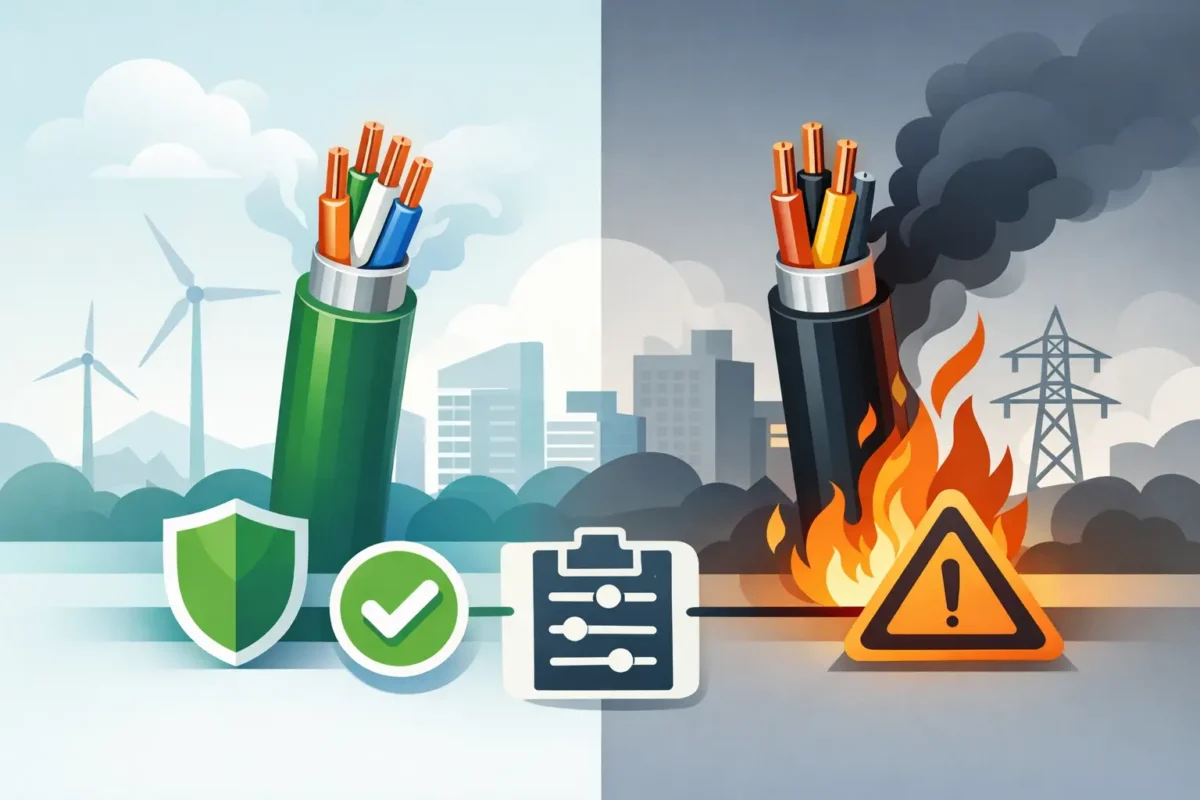
LSZH PVC cable: understand the differences, risks, and specification criteria for safety, performance, and compliance in real-world critical industrial applications.
An incorrect cable specification in an industrial area can transform a localized event into a prolonged shutdown, impacting the safety of people, assets, and operational continuity. Therefore, the search for LSZH PVC cable requires an analysis beyond the commercial name: LSZH and PVC indicate distinct behaviors in the presence of fire, smoke, generated gases, and installation conditions.
In critical projects, the decision should not be reduced to "LSZH is better than PVC" or vice versa. The appropriate material depends on the circuit's function, cable routing, population density, fire suppression strategy, regulatory requirements, and the mechanical, chemical, and thermal conditions of the environment. Proper specification means aligning construction composition and measurable performance with the actual application risk.
LSZH PVC Cable: Why the nomenclature requires attention.
LSZH stands for Low Smoke Zero Halogen , meaning low smoke emission and absence of halogens. In cables with this characteristic, the insulating and/or sheathing materials are formulated to reduce the emission of opaque smoke and corrosive halogenated gases when exposed to fire. This behavior can be crucial in enclosed environments, escape routes, control rooms, data processing centers, platforms, vessels, tunnels, and installations with a high concentration of electronic equipment.
PVC, in turn, is polyvinyl chloride, a polymer widely used in cable insulation and sheathing. It is a well-established solution for various applications due to its balance between cost, processability, mechanical strength, and electrical performance. However, because it contains chlorine in its composition, PVC is not considered halogen-free. When subjected to combustion, it can release corrosive gases and smoke with characteristics that need to be evaluated in the context of installation safety.
Therefore, the term LSZH PVC cable may appear in commercial inquiries, comparisons, or incomplete project descriptions, but it should not replace an analysis of the product's construction. A cable with a PVC outer sheath does not become LSZH simply because it has some internal component with low smoke emission. Similarly, an LSZH cable needs to have its composition, tests, and performance limits clearly documented.
The specification must indicate, for each relevant layer, the material and property required: conductor insulation, fillers, separators, shielding, inner sheath, and outer covering. This discipline prevents generic terms from being interpreted as safety requirements already met.
What to compare between LSZH and PVC
The choice of materials should consider the failure scenario, not just normal operation. In an open industrial plant with low occupancy and external cable routes, a PVC sheath may fully meet the technical and economic requirements of the project. In an enclosed substation, a critical panel, a ship , or an evacuation route, the reduction of smoke and corrosive gases may be of much greater importance.
Smoke, toxicity and corrosiveness
The main advantage of LSZH compounds lies in their behavior during a fire. Lower smoke emission can improve visibility for evacuation and intervention by fire crews. The absence of halogens reduces the risk of the formation of corrosive acid gases, which can damage panels, instruments, automation systems, and electronic components even outside the main fire area.
This improvement does not eliminate the need to assess toxicity, flammability, and flame propagation. A halogen-free cable is not automatically non-flammable, just as a flame-retardant cable is not automatically LSZH (low-zero zorbit). These are different properties, proven by specific tests.
Mechanical and environmental performance
LSZH formulations may exhibit different mechanical characteristics compared to traditional PVC formulations. Flexibility, abrasion resistance, low-temperature behavior, resistance to oils, fuels, chemicals, and solar radiation need to be confirmed for each project.
In systems subject to continuous movement , such as robotics, conveyors, lifting equipment, and automated machines, the sheathing compound must withstand bending cycles and dynamic stresses without compromising electrical integrity. Simply defining LSZH or PVC is not enough; it is necessary to specify the minimum bending radius, number of cycles, travel speed, acceleration, torsion, and presence of contaminants.
Total cost of installation and operation
PVC tends to offer a competitive solution in conventional applications, while LSZH compounds may require a higher initial investment. However, this comparison cannot be made solely based on price per meter. In a critical installation, the costs of post-fire corrosion, system downtime, instrument replacement, and risks to people can far outweigh the initial cable price difference.
Proper analysis considers total cost of ownership, circuit criticality, and failure consequences. In environments where the risk associated with smoke and corrosiveness is low, PVC may be technically adequate. Where human safety and the preservation of electronic assets are priorities, LSZH may be the most appropriate choice.
Standards and tests that need to be included in the project.
The material designation does not replace the requirement for normative testing. The descriptive report must list the standards applicable to the expected performance and indicate the edition valid for the contract, the voltage class, the construction, and the installation environment.
For fire behavior , some recurring international references include the IEC 60332 series, focused on flame and fire propagation tests; IEC 60754, related to the acidity and conductivity of gases generated by combustion; and IEC 61034, used to evaluate smoke density. When the circuit needs to remain functional during a fire, circuit integrity requirements may also be applicable, such as the tests in the IEC 60331 series.
The applicable standard varies by sector. Naval, railway, oil and gas, mining, energy, airport, and building projects may incorporate their own requirements, classification standards, utility requirements, or end-user engineering criteria. The key point is not to accept a generic "flame-retardant cable" declaration when the project requires low smoke emission, absence of halogens, or maintenance of operation under fire.
In addition to fire tests, the documentation should cover electrical parameters, insulation resistance, electromagnetic shielding, conductor resistance, test voltage, operating temperature, oil resistance, and mechanical properties. For instrumentation and control cables, signal stability and shielding can be as critical as the outer sheath.
How to specify the cable for the correct application
A good specification starts with the circuit's function. Power, control, instrumentation, communication, servo drive, and variable frequency cables face different demands. A cable for a frequency inverter, for example, may require construction with adequate shielding and attention to electromagnetic compatibility, while an instrumentation cable may demand twisted pairs, individual or collective shielding, and low capacitance.
Next, it is necessary to map the environment. Continuous and overload temperature, humidity, sun exposure, salt spray, oil, chemicals, vibration, impact risk, and the presence of rodents directly influence the construction. In classified areas or areas with high fire safety requirements, the installation route and proximity to people should guide the selection of materials.
It is also necessary to define the performance in case of fire. Does the cable only need to limit flame propagation? Should it emit little smoke? Does it need to be halogen-free? Should the circuit remain energized for a certain period? Each answer leads to a specific combination of materials, shielding, armor, and testing requirements.
Finally, validate the compatibility between cable, installation method, and accessories. Cable glands, connectors, cable trays, conduits, junction boxes, and grounding systems influence safety and service life. An LSZH cover installed with inadequate accessories or subjected to a bending radius smaller than recommended may lose performance before commissioning.
Errors that compromise the technical decision.
The first mistake is treating LSZH as synonymous with fire-resistant cable. LSZH cables may be flame retardant, but fire resistance and maintenance of circuit integrity depend on specific construction and testing.
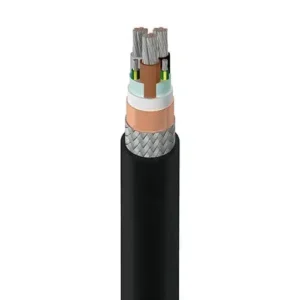
Another common mistake is choosing solely based on the outer sheath. For specialized cables, the solution needs to be analyzed as a whole. Flexible or rigid conductor, stranding class, insulation, shielding, drain wire, armor, and sheath must all meet the actual demands of the system.
It is also risky to copy a specification from another project without reviewing the installation conditions. A cable approved for indoor use may not withstand UV exposure, contact with oil, low temperatures, or continuous bending. Standardization is valuable, but it needs to be technically controlled.
Applied engineering to reduce field risks.
The best specification is one that translates operational risk into verifiable requirements. Instead of simply requesting "LSZH cable" or "PVC cable," define the application, the standard, the necessary fire tests, the environmental conditions, and the mechanical and electrical limits of the circuit.
For on-demand projects, cable engineering allows for the combination of materials and constructions to meet specific requirements without introducing unnecessary features that increase costs or complicate installation. With in-house manufacturing and technical application evaluation, Innovcable develops solutions for operations where performance, deadlines, and reliability must go hand in hand.
Before authorizing the purchase, transform the specification into an objective question: will this cable remain safe, functional, and compatible with the installation under the most severe conditions anticipated? When the answer is supported by construction, standards, and testing, the cable ceases to be just a list item and becomes a safeguard for the continuity of your process.