Domestic or imported industrial cable: compare performance, standards, lead time, and total cost to specify critical cables safely and predictably.
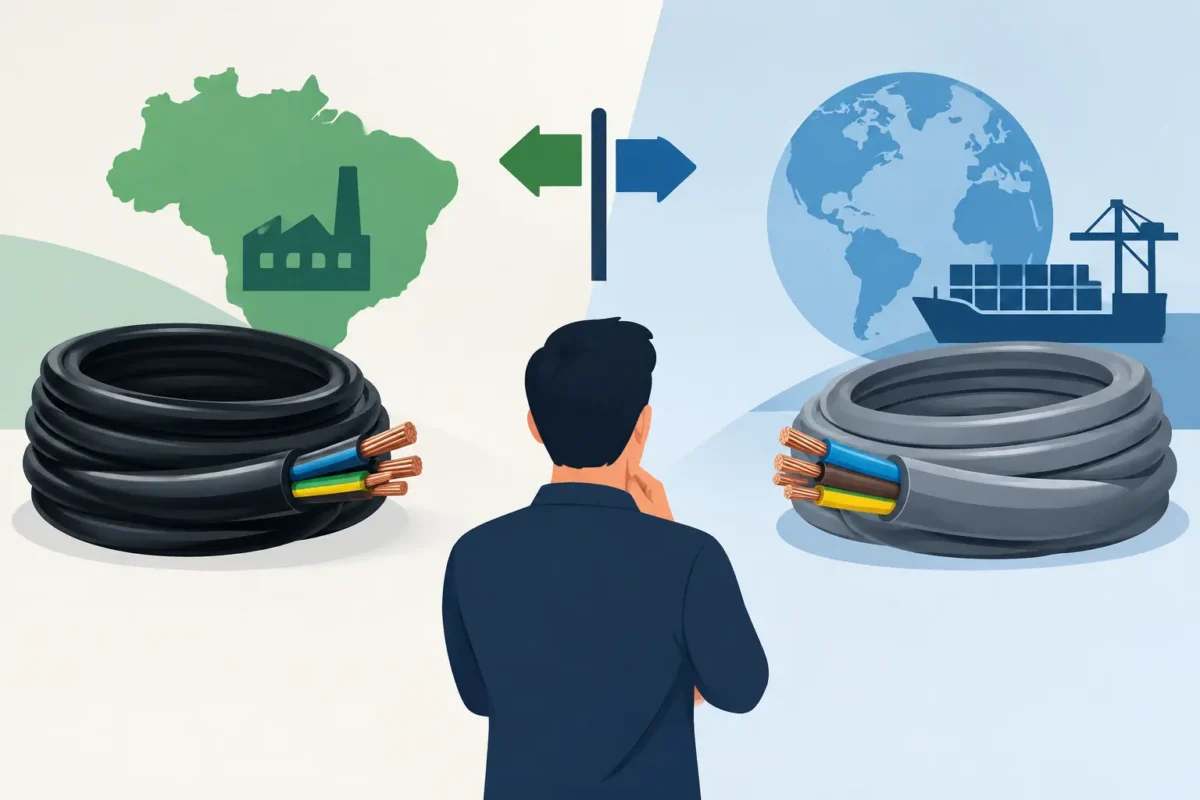
An unscheduled shutdown in a production line, pumping system, or port operation rarely begins with a seemingly simple purchasing decision. Even so, the choice between domestically produced or imported industrial cable can define asset availability, installation safety, and the true cost of the project in the coming years. The central point is not the product's origin. It's the cable's proven ability to meet the electrical, mechanical, thermal, chemical, and regulatory requirements of the application.
In critical industrial applications, comparing only price per meter or nominal section leads to weak specifications. A control cable on a conveyor belt, an instrumentation cable in a harsh environment, or a power cable feeding a frequency inverter needs to be evaluated as part of the system. Its construction, materials, documentation, and the supplier's response to a technical need have a direct impact on operational continuity.
Domestic or imported industrial cable: the decision begins with the application.
There is no universal answer. There are projects where an imported product already approved by corporate engineering may be suitable, especially when there is global standardization, proprietary requirements, or a machine architecture defined by the original manufacturer. In other cases, domestic manufacturing offers significant gains in terms of lead time, technical adaptation, support, and replacement parts.
The decision should start with objective questions: What is the operating voltage? Is there continuous movement, twisting, or bending? Does the environment expose the cable to oil, abrasion, humidity, UV radiation, salt water, high temperatures, or chemical agents? Does the installation require low smoke emission, flame retardancy, electromagnetic shielding, or compliance with a specific standard?
Without these answers, the comparison between domestic and imported cables is limited to commercial conditions. In the case of specialized cables, this is an insufficient criterion. Two products with the same gauge can exhibit completely different behaviors in bending cycles, crush resistance, thermal stability, and immunity to interference.
What to consider beyond the purchase price
The initial cost is visible in the quote. The effects of an inadequate specification appear later, in corrective maintenance, lost production, premature replacement, and safety risks. Therefore, the most consistent criterion is the total cost of ownership.
A cable for robotics, for example, needs to withstand the real dynamics of acceleration, bending radius, speed, and number of cycles of the equipment. Applying a conventional cable in a cable carrier may reduce the initial investment, but increases the likelihood of conductor breakage, sheath wear, and intermittent failures. In automation, an intermittent failure can consume many hours of diagnosis before being identified.
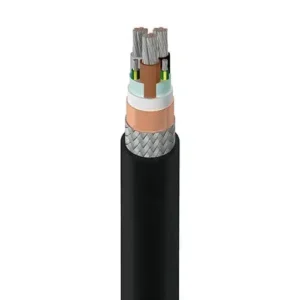
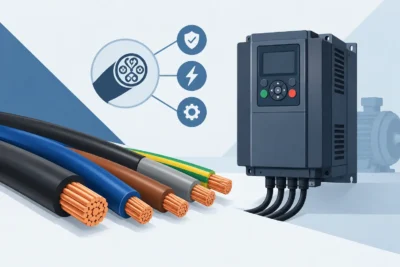
It is also necessary to analyze the product's technical composition. Flexible conductors, insulation, shielding, fillers, tensile elements, outer covering, and stranding geometry must be aligned with the intended use. In systems with frequency inverters and servomotors, for example, shielding, capacitance, insulation resistance, and proper construction help control effects associated with voltage pulses, electromagnetic interference , and electrical stress.
Documentation is an integral part of this analysis. Technical data sheets, batch traceability, test reports, declarations of conformity, and clear product identification reduce uncertainties during assembly, inspection, and maintenance. For EPC contractors, integrators, and machine manufacturers, this also simplifies approval and commissioning processes.
Practical advantages of domestic manufacturing
The main advantage of a domestically produced industrial cable is not just geographical proximity. It's the ability to transform a field need into an engineering solution with less distance between specification, development, manufacturing, and delivery.
When an installation presents routing limitations, specific connectors, outside diameter requirements, special lengths, or an unusual combination of mechanical and chemical resistance, customization can be crucial. A technically skilled local manufacturer can evaluate construction alternatives, adapt materials, and guide the application without relying exclusively on a closed catalog.
Delivery time also needs to be treated as a risk variable. Imported items may be available quickly when kept in stock in Brazil. However, special products, made to order, or subject to logistical variations may face longer lead times, import processes, currency fluctuations, and unavailability of replacement parts. For a plant that needs to recover a critical operation, supply predictability is as important as the initial specification.
Another factor is after-sales support. In case of failure, installation doubts, or the need for technical analysis, direct interaction with engineering and quality control facilitates the investigation. This doesn't mean automatically attributing the problem to the cable. The cause could be an inadequate bending radius, excessive tension, incorrect cable gland, overheating, chemical incompatibility, or assembly outside of recommendations. An engineering partner helps to separate symptom from root cause.
Innovcable operates precisely in this area: manufacturing special cables on demand, with quality control and applied engineering for demanding industrial environments. For projects that don't fit off-the-shelf solutions, nationalizing the solution can reduce dependencies without lowering the required technical level.
When imported cable might be the right choice
Being domestically produced is not, in itself, a guarantee of suitability, just as being imported does not automatically represent higher performance. An imported product may be the right choice when the project requires a specific certification not yet available locally, when there is mandatory OEM approval, or when the installation integrates a global platform with predefined materials.
There are also situations where international manufacturing scale or a local distributor's stock makes a particular item competitive in terms of delivery time and cost. The key is to confirm that the purchased part number is exactly the same as the product qualified for the application. Substitutions based on commercial equivalents, without validating electrical and mechanical parameters, represent a risk.
Before opting for importation, it is worth checking the continuous availability of the model, the replacement lead time, the existence of documentation in Portuguese when necessary, the technical support channel, and compatibility with standards applicable to the project. An item suitable for the country of origin may not fully meet the installation, safety, or certification requirements stipulated in Brazil.
Standards, tests and proven performance.
Standards are fundamental references, but they do not replace the analysis of the conditions of use. IEC, NEK-606, American standards, and national requirements guide construction characteristics and testing methods. In naval, railway, airport, photovoltaic, mining, and oil and gas applications, selection typically involves additional requirements for flame, smoke, halogen, oil resistance, UV, ozone, mud, water, and mechanical exposure.
The correct question is not simply "Does the cable meet the standard?". It is "Do the standard, construction, and tests presented correspond to the operational risk of this application?". An oil-resistant cable does not necessarily withstand continuous bending. A cable with good mechanical resistance may not be suitable for electromagnetic interference. A product for fixed installation should not be used in moving applications simply because it has a thick covering.
Therefore, the specification must record the critical conditions: voltage, current, temperature, flexibility class, path, minimum bending radius, travel speed, tensile force, environmental exposure, shielding requirements, and regulatory requirements. The clearer the engineering input, the more precise the solution provided.
A purchasing process that reduces risk.
To compare proposals for domestic and imported cables consistently, request an analysis based on the same descriptive specifications. Compare cross-section and voltage, but also conductor class, insulation and sheathing materials, shielding, outer diameter, mass, bending radius, operating temperature, chemical and mechanical resistance, standards, and documentation.
Also consider batch fulfillment capacity, manufacturing repeatability, and lead time. Industrial projects don't end with the first delivery. Future maintenance, plant expansions, and machine replication require that the specification remains available and controlled.
In more critical purchases, validation through sampling, document inspection, or targeted testing can prevent disproportionate costs in the field. The goal is not to bureaucratize the acquisition process. It is to ensure that the selected cable performs in a way that is compatible with the responsibility it will assume within the system.
The best choice is not defined by the cable's passport, but by the engineering that underpins its application. When performance, standards, availability, and technical support are analyzed together, the purchase ceases to be a comparison of meters and becomes about protecting the outcome of the operation.