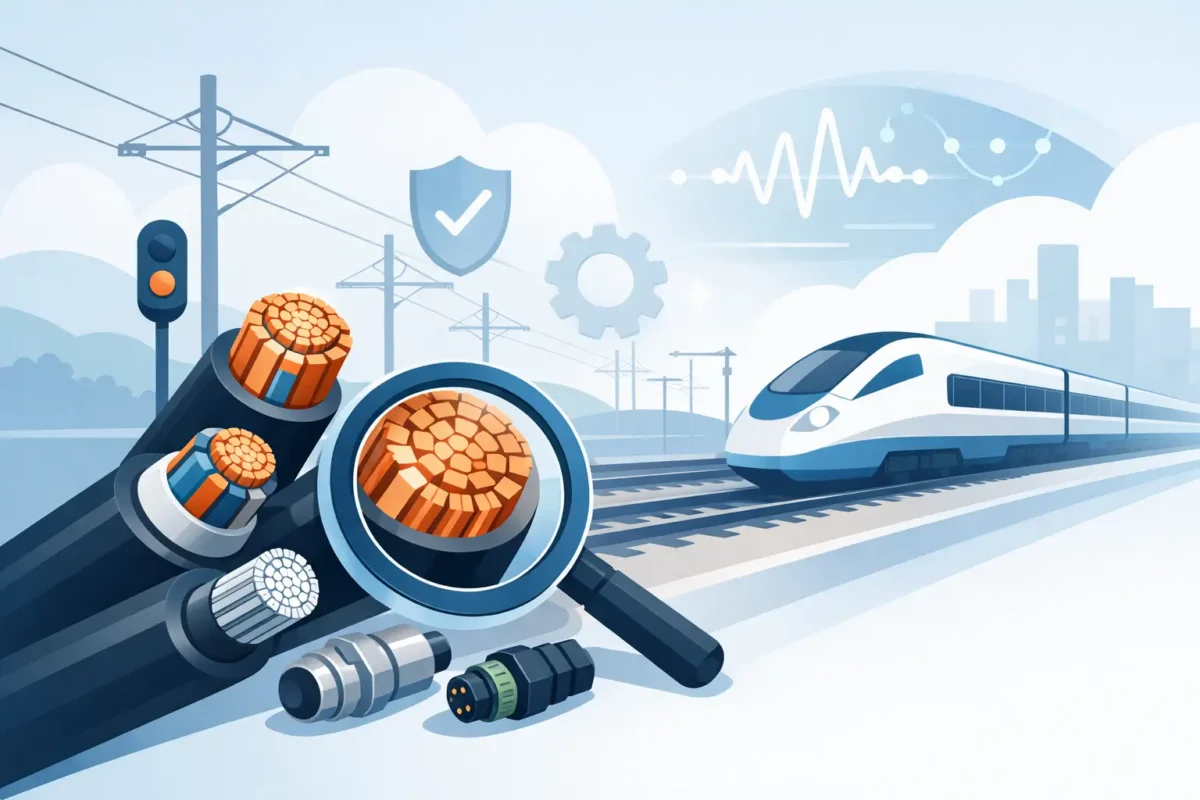
Railway cables require resistance to vibration, fire, and weather. Learn how to specify reliable solutions for rolling stock and permanent way.
A signaling, traction, or communication failure on a railway is not limited to replacing a single component. It can disrupt operations, affect passenger and cargo safety, cause asset downtime, and increase maintenance costs. Therefore, railway cables must be specified as a critical part of the system's engineering, considering the environment, service regime, applicable standards, and expected service life.
In the railway sector, cables rarely operate under stable conditions. Continuous vibration, bending cycles, abrasion, thermal variations, humidity, dust, salt spray, and exposure to oils or fuels are all part of the reality of rolling stock, yards, tunnels, workshops, and permanent way installations. Choosing a cable based solely on conductor cross-section and nominal voltage creates a technical gap that often becomes apparent in the field.
How to specify railway cables using technical criteria.
The specification should begin with the electrical function of the circuit. Power cables for auxiliary, traction, or equipment power supply have different demands than cables for control, instrumentation, communication, signaling, and data. Each application determines requirements for current, voltage drop, electromagnetic shielding, capacitance, impedance, insulation resistance, and mechanical behavior.
In control and signaling circuits, for example, signal integrity is as important as electrical continuity. Noise generated by frequency inverters, motors, relays, traction systems, and other electromagnetic sources can compromise sensor readings and communication between equipment. In these cases, construction with adequate shielding , twisted pairs when necessary, and correctly defined grounding reduces interference and makes the system more predictable.
In embedded power applications, the operating current, starting currents, conductor temperature, and installation in bundles or cable trays need to be evaluated together. A cable sized only for the nominal current may overheat when installed in bundles, confined spaces, or points with low heat dissipation. The current-carrying capacity must reflect the actual mounting conditions, not just the catalog data.
The environment defines the cable's construction.
The location of the circuit is crucial. Inside a railway vehicle, the cable may face vibration, confined space, door movements, bogies, moving equipment, and stringent fire safety requirements. In outdoor installations, UV radiation, rain, flooding, dust, chemical attacks, and large temperature variations come into play.
The outer cover must be compatible with these agents. Elastomeric compounds, special thermoplastics, or materials with low smoke and corrosive gas emission characteristics may be necessary depending on the application. There is no universally superior cover: there is a more suitable composition for each operational risk. A very rigid cover may not withstand movement cycles well; a cover designed for flexibility may require additional validation against abrasion or chemicals.
It is also necessary to define whether there will be continuous bending, twisting, or occasional movement. Cables installed in doors, lifting systems, connections between cars, technical conveyors, and mobile equipment require constructive geometry, stranding, and materials developed for mechanical cycles. Using a fixed cable in a dynamic application reduces its lifespan and increases the risk of internal breaks that are not always visible during an external inspection.
Fire safety is a design requirement.
In railways, especially in passenger transport and in confined areas, cable behavior in fire situations is a safety element of the system. Flame propagation, smoke generation, emission of halogenated and corrosive gases, and the maintenance of essential circuits must be addressed according to the criticality of the installation.
Standards such as EN 45545-2, IEC 60332, IEC 60754, and IEC 61034 are frequent references for evaluating fire performance, although the final requirement depends on the design, the operator, the type of rolling stock, and the contractual conditions. Simply stating that the cable is "flame-retardant" is not enough. This classification is insufficient when the application requires low smoke emission, low toxicity, low corrosiveness, or circuit integrity for a specific period.
Emergency communication, detection , safety lighting, and control systems may require continued functionality when exposed to fire. For these circuits, engineering must evaluate the entire installation, including supports, connectors, cable glands, junction boxes, and fastening method. The correct cable loses some of its function when the other components do not maintain the same level of performance.
Shielding, grounding, and electromagnetic compatibility
Embedded electronics have increased the importance of electromagnetic compatibility in the railway sector. Monitoring, door control, telemetry, diagnostics, communication, and automation systems coexist with higher power loads. Without a physical separation and shielding strategy, low-intensity signals can suffer interference and generate intermittent faults that are difficult to trace.
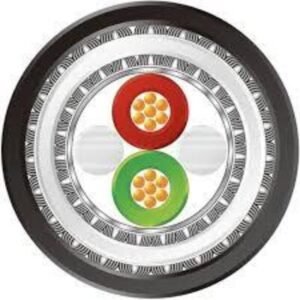
Shielding can consist of metallized tape, copper braid, a combination of layers, or specific solutions for the frequency and level of interference involved. The choice depends on the noise source, the sensitivity of the circuit, and the installation path. Efficient shielding, but improperly grounded, may not deliver the expected result.
The project must also provide for the segregation of power, signal, and data cables. Crossings, paralleling over long stretches, proximity of inverters, and shared grounding need to be analyzed. In critical systems, this decision must be documented in the electrical architecture, preventing improvised adaptations during assembly or maintenance.
Mechanical durability reduces unscheduled downtime.
The strength of a cable extends beyond its outer sheath. Conductor stranding, concentricity control, layer adhesion, tensile strength, and dimensional stability directly influence its service life. In railway operations, constant vibration and mechanical shocks can accelerate conductor and insulation fatigue when the construction was not designed for this scenario.
Installation is another crucial factor. Minimum bending radius, maximum tensile strength, cable tray occupancy, fastening, protection against sharp edges, and identification must follow the design and manufacturer's guidelines. A technically adequate cable can be damaged even before the system starts if it is pulled with excessive force or bent below the recommended limit.
To reduce risks, the specification should include at least four groups of information: circuit function and electrical parameters; environmental and mechanical conditions; fire requirements and design standards; installation, connection, and grounding method. This set allows for a technical comparison of proposals, avoiding superficial equivalences between products of different constructions.
Custom manufacturing for railway applications.
Railway projects often require specific features not available on conventional lines. There may be a need for particular combinations of conductors, colors, numbering, shielding, sheathing, thermal classes, nominal cross-sections, outside diameters, or technical documentation. Custom manufacturing allows the solution to be tailored to the available space, equipment architecture, and customer requirements, without sacrificing performance to accommodate a generic item.
This approach is especially relevant for fleet modernizations, replacement of old systems, and nationalization of components. In these scenarios, the challenge is not just to reproduce a physical measurement. It's about understanding the original application, validating the operating environment, and developing a solution that maintains or enhances safety and reliability requirements.
Innovcable specializes in applied engineering and the manufacturing of specialized cables for demanding industrial environments, supporting the design of structures that meet the electrical, mechanical, and regulatory requirements of each project. Quality control is maintained from the raw materials to the dimensional, electrical, and functional verifications required for the application.
The choice of a railway cable should not occur at the final stage of the purchase, when deadlines and price already dominate the decision. The sooner engineering assesses route, mobility, environmental exposure, fire risk, and electromagnetic interference, the greater the ability to prevent failures. In an operation that cannot stop, the cable ceases to be an installation item and becomes a direct part of the asset's reliability.