Cables for harsh environments require appropriate engineering, materials, and standards. Learn how to specify them to reduce failures and industrial downtime.
A cable failure in a mining plant, on a naval deck, or in an automated line is rarely an isolated event. It can interrupt production, compromise instrumentation data, create safety risks, and increase maintenance costs. Therefore, the choice of cables for harsh environments must be based on actual operating conditions, not just nominal voltage, conductor cross-section, or price per meter.
In critical applications, the cable is a functional component of the system. It needs to maintain electrical, mechanical, and chemical integrity in the face of simultaneously acting factors: heat, humidity, oil, abrasion, vibration, bending, tension, corrosive agents, and sun exposure. Proper specification means anticipating these stresses and translating field realities into verifiable construction requirements.
What characterizes a harsh environment?
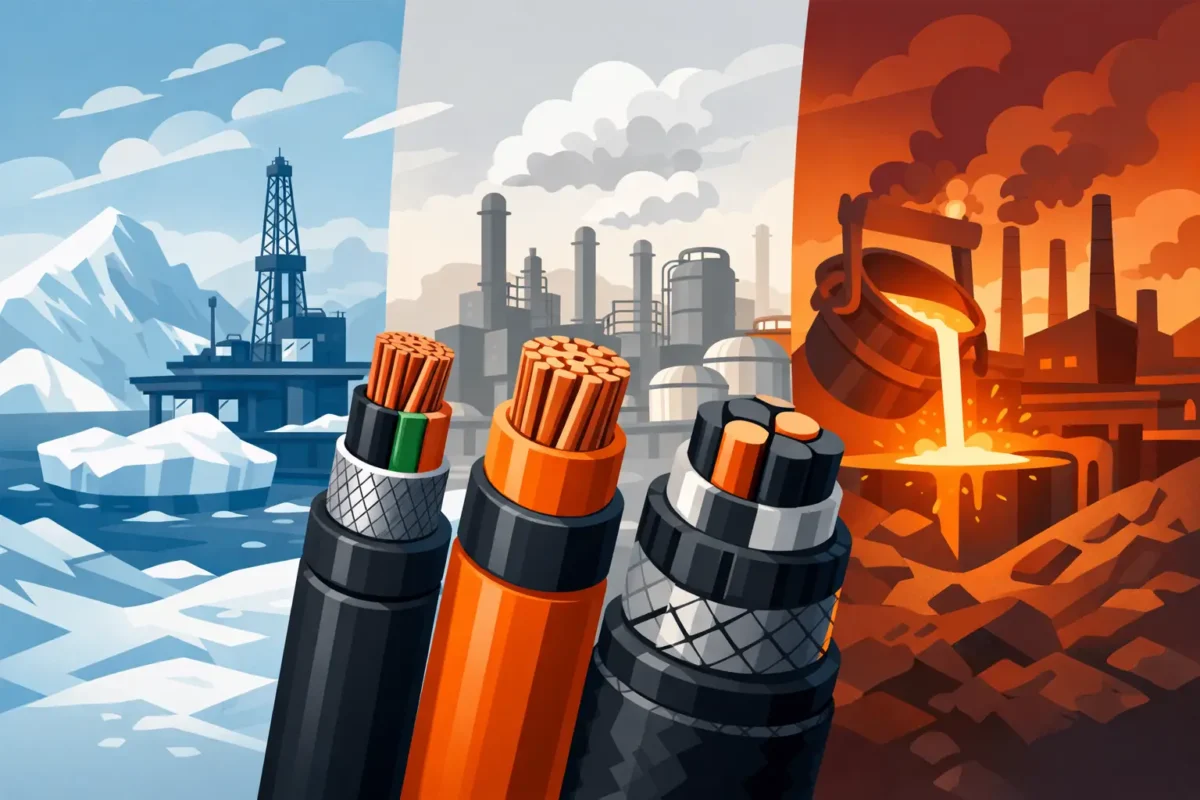
Harsh environments are not a single category. They represent a combination of conditions that exceed the capabilities of a conventional cable over time. A cable carrier in continuous operation, for example, demands dynamic behavior. An oil and gas installation, on the other hand, may require chemical resistance, low smoke emission, flame retardancy, and compliance with specific standards.
In naval and offshore areas, salt spray, high humidity, hydrocarbons, and vibration pose simultaneous challenges. In steelmaking, mining, and cement, abrasive dust, mechanical impact, and high temperatures accelerate the degradation of unsuitable materials. In photovoltaic systems, UV radiation, thermal variation, and weathering define the installation's lifespan.
The crucial point is that the environment should not be described in a generic way. Information such as minimum and maximum temperature, presence of oil, type of movement, radius of curvature, tensile stress, bending frequency, contact with water, and fire resistance requirements must be included in the descriptive report.
Cables for harsh environments: what to consider
Technical selection begins with the circuit's function. Power, control, instrumentation, data, servomotor, and frequency inverter cables face different risks, even when installed in the same industrial area. An instrumentation cable may require shielding to preserve signal quality; a motor cable driven by an inverter needs to handle voltage pulses and electromagnetic interference; a motion cable requires a construction prepared for repetitive cycles.
Insulation and roofing material
PVC, HEPR, EPR, XLPE, polyurethane, and specialty compounds exhibit distinct behaviors when exposed to temperature, abrasion, oil, ozone, UV rays, and chemicals. There is no universally superior material. The only suitable compound is the one best suited to the intended use and expected lifespan.
Rubber coatings, for example, are commonly used in cables intended for heavy industrial use, mobile equipment, and applications requiring flexibility. Polyurethane, on the other hand, may be indicated when abrasion is a dominant factor. In outdoor installations, resistance to solar radiation and weathering must be proven for the chosen construction.
Chemical compatibility must also be considered. The term "oil resistant" does not eliminate the need to identify the type of oil, fluid, or solvent present. A compound may perform well with mineral lubricants and behave poorly with more aggressive agents.
Mechanical performance in motion
Flexion is not just bending the cable during installation. In robotics, overhead cranes, cable carriers , and lifting systems, the conductor undergoes repetitive motion throughout the operation. In this scenario, the stranding class, internal geometry, filling, element twist, and minimum bending radius directly influence durability.
A cable designed for fixed installation may fail prematurely if used in a conveyor belt. Similarly, a cable designed for continuous bending may represent an unnecessary cost in a static section without mechanical requirements. The specification should clearly distinguish between fixed installation, occasional bending, continuous bending, twisting, and tensile stress.
For dynamic applications, it is worthwhile to define objective parameters: speed, acceleration, travel, conveyor orientation, predicted number of cycles, and available radius of curvature. This data allows engineering to evaluate a solution consistent with the actual movement of the equipment.
Shielding and electromagnetic compatibility
Environments with frequency inverters, drives, motors, automation panels, and industrial networks can exhibit significant levels of electromagnetic interference. Noise in analog signals, communication failures, and unstable instrument readings do not always originate from the electronic device. The cable routing and construction can be a central part of the problem.
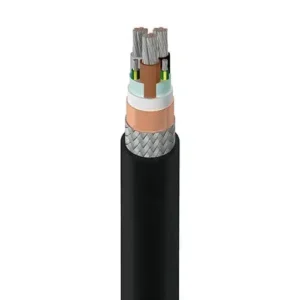
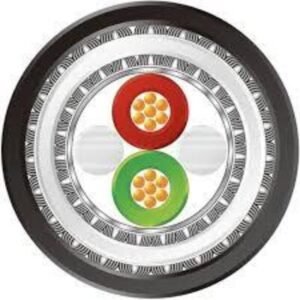
Shielding can be made of tape, metal braid, or a combination of both, depending on the frequency of the interference, the required flexibility, and the expected electromagnetic performance. Grounding of the shielding also needs to be addressed in the design. A correctly selected shield, but poorly finished in the field, loses a significant part of its function.
In cables for servomotors and frequency inverters, the construction must consider interference containment, the integrity of the grounding system, and the protection of the insulation against the electrical stresses characteristic of electronic drives.
Fire safety and regulatory requirements
In escape routes, platforms, vessels, tunnels, critical buildings, and industrial processes, the behavior of the cable in case of fire can be crucial. Requirements may include flame retardancy, low smoke and corrosive gas emissions, or maintaining circuit integrity for a specified period.
These properties are not equivalent. A flame-retardant cable reduces the spread of fire, but does not necessarily keep the circuit operational under fire. A fire-resistant cable is designed to preserve electrical continuity under specific test conditions. The choice depends on the circuit's function, the safety strategy, and the standards applicable to the project.
National standards, IEC, NEK-606, and American standards can guide materials, testing, identification, and performance. However, citing a standard without validating its adherence to the application does not resolve the specification. The responsible engineer must confirm which requirements are mandatory, which are contractual, and which are necessary to mitigate operational risk.
How to transform field requirements into specifications.
Technical purchasing gains precision when the requester provides a minimum set of information. Beyond voltage, number of conductors, and nominal cross-section, the manufacturer needs to know the application, installation method, temperature, contact with chemical agents, shielding requirements, fire behavior, and movement conditions.
In special projects, the length of supply, conductor identification, sheath color, armor requirements, flexibility class, and documentation requirements are also relevant. Certificates, raw material traceability, test reports, and dimensional control can be crucial for EPC contractors, OEMs, and regulated operations.
A good practice is to analyze the previous fault before replacing the cable. Was there a conductor break? Crack in the sheath? Water infiltration? Signal interference? Oil degradation? Overheating? Each piece of evidence points to a likely cause and avoids repeating the improper application with a product that is merely similar to the previous one.
The cost of the cable should be measured by its operation.
In critical environments, comparing cables solely based on initial cost may produce an apparent saving. The real cost includes machine downtime, team mobilization, material disposal, accident risk, project delays, and lost production. A technically compatible cable tends to reduce unplanned interventions and provide predictability to maintenance.
This doesn't mean oversizing each circuit. The goal is to match performance to the severity of the application. A well-specified design balances technical requirements, availability, deadlines, and total cost of ownership.
Innovcable develops solutions for applications where the cable needs to keep pace with the operation, with in-house manufacturing, quality control, and the possibility of customization according to project demands. For the technical buyer, the best decision begins with a simple question: what stresses will this cable face every day? The answer should guide the engineering team before the order is placed.