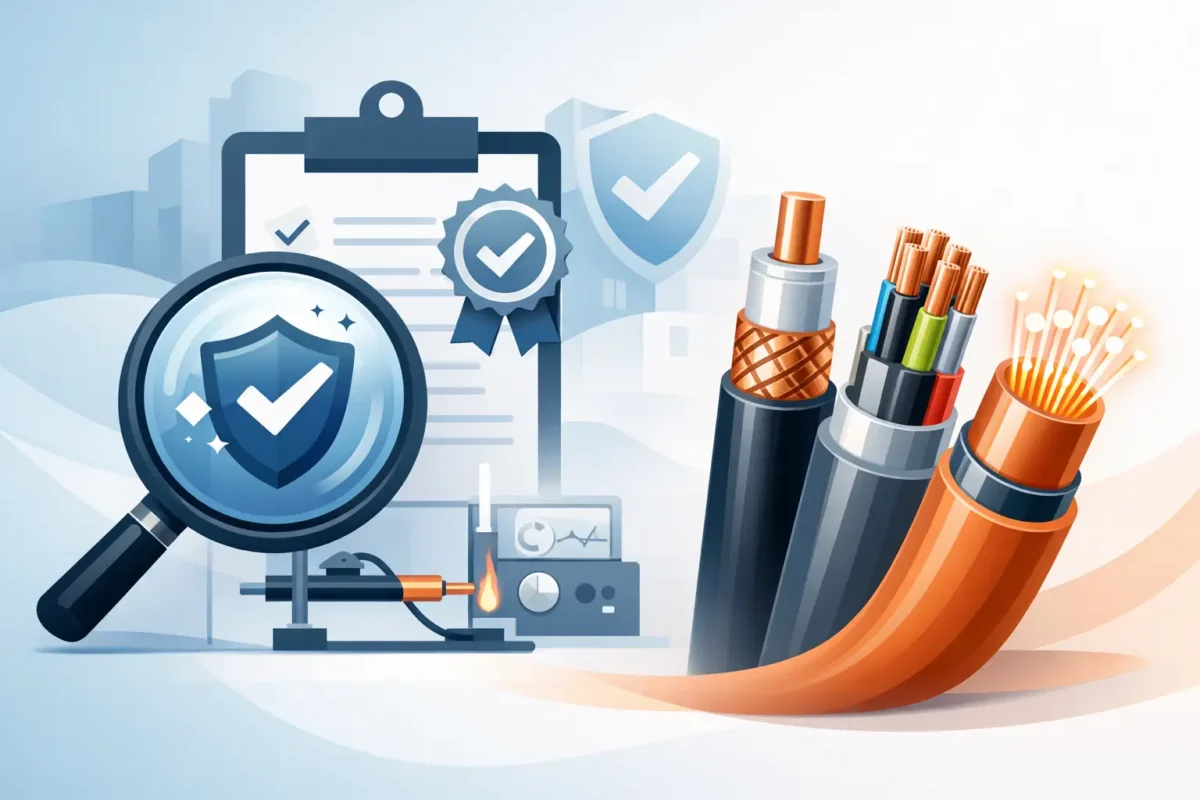
Understand what UL certification for cables proves, when it is required, and how to specify it to reduce risks in critical industrial projects in the field.
A non-compliance can halt a shipment, cause a panel to fail inspection, or prevent a machine from entering a strategic market. Therefore, the pursuit of UL certification for cables should not begin with the product label, but with the application, the destination country, and the regulatory requirements of the entire equipment.
In industrial projects, the acronym UL is often associated with safety, acceptance in the North American market, and traceability. This association is correct, but incomplete. A cable with UL marking is not automatically suitable for any environment, voltage, bending regime, or installation method. Certification is linked to a defined construction and scope of use. Correct specification requires verifying the applicable standard, the identification printed on the sheath, and the documentation that supports that approval.
What does UL certification in cables prove?
UL stands for Underwriters Laboratories, an internationally recognized organization for product safety assessment. For cables, approval may involve tests and controls related to flammability, electrical resistance, rated voltage, insulating materials, insulation and sheath thicknesses, identification, conductor composition, and performance under specific conditions stipulated by the standard.
In practice, the UL mark indicates that a particular building family has been evaluated according to an applicable standard and remains subject to a production monitoring program. This is crucial: it's not just about approving an initial sample. Maintaining compliance depends on controlled materials, a repeatable production process, quality records, and periodic inspections.
The exact meaning of the mark depends on the category. In some cases, the cable is listed for a specific installation or end use. In others, it may be recognized as a component for integration into equipment, panels, or assemblies that will also undergo evaluation. Confusing these two conditions is a recurring source of rework in export projects.
Listed, Recognized, and AWM: Differences that change the specification.
The first technical question should not simply be "does the cable have UL certification?", but "what is the UL designation and what uses does it permit?". This distinction impacts equipment approval, field assembly, and acceptance by the competent authority during installation.
A UL Listed cable typically has a rating geared towards a specific end application or installation method specified in the standard. Cables for cable trays, for example, may follow different requirements than cables intended for communication circuits, portable power supplies, or building installations.
A UL Recognized component is intended for incorporation into a larger product. It may be suitable for the interior of a machine, an electrical panel, or an industrial assembly, provided that the acceptability conditions established in the technical file are respected. External use or use in a cable routing system, however, may require a different classification.
The AWM designation, for Appliance Wiring Material, is very common in wiring harnesses, panels, automation equipment, servo drives, and machines intended for the American market. An AWM style defines parameters such as voltage, temperature, insulation type, and construction. However, AWM should not be treated as a generic authorization for any building or industrial installation. The designer needs to evaluate the applicable electrical code, the environment, and the requirements of the client or inspector.
UL standards most commonly used in industrial projects
There is no single standard that represents all UL cable certifications. The correct reference depends on the electrical function, installation method, and operational severity. Common examples include UL 758 for equipment wiring materials, including AWM styles; UL 62 for flexible cables; UL 1277 for certain power and control cables in cable trays; UL 444 for communication cables; and UL 13 for limited power circuit cables.
Flame propagation and fire behavior requirements may also be relevant, depending on the application and installation route. Tests such as those associated with plenum, riser, or tray cables are not interchangeable. A good response in a flame test does not, by itself, replace the classification required for another installation scenario.
In automation systems, the challenge often lies in combining requirements. A cable for a frequency inverter may demand efficient shielding , electromagnetic compatibility, adequate voltage, oil resistance, and approval compatible with the target market. For robotics and conveyors , bending cycles, minimum bending radius, speed, acceleration, torsion, and temperature also come into play. Regulatory marking is part of the solution, not the entire solution.
When UL is required and when it doesn't solve everything.
UL certification is especially relevant when the cable is integrated into machines, panels, skids, OEM equipment, or systems that will be exported to the United States, Canada, or markets that adopt similar requirements. It may also be a contractual requirement for multinational companies, integrators, or end users who standardize their purchases according to American standards.
In Brazil, the need must be analyzed on a case-by-case basis. There are projects governed by ABNT and IEC standards, utility company requirements, sector regulations, mandatory certifications, and each client's own specifications. UL certification can add technical value and facilitate the acceptance of equipment intended for export, but it does not automatically replace Brazilian obligations or specific plant requirements.
The key point is that regulatory compliance and engineering adequacy must go hand in hand. A cable approved for a given voltage and temperature may not withstand hydrocarbons, oil mist, salt water, abrasion, UV radiation, corrosive atmospheres, or continuous movement. In marine, mining, oil and gas, port, airport, and automated pipeline environments , the specification must consider all these variables.
How to specify UL-certified cables without creating project risk.
The best specification starts with the circuit and installation, not the commercial code. Define whether the cable will be used internally in equipment or installed in the field, whether it will carry power, control, data, or an analog signal, and what the operating voltage, current, and temperature will be. Then, assess the environment: presence of oil, chemical agents, humidity, salinity, solar radiation, fire hazard, electromagnetic interference, and mechanical stress.
It is also necessary to specify if there is movement. In static applications, priority may be given to thermal, chemical, and flame resistance. In dynamic applications, the cable design needs to withstand repetitive bending, twisting, tension, and abrasion wear without compromising electrical continuity or shielding. A certified cable, but designed for static use, tends to fail prematurely in a cable carrier.
In the technical request, it is worthwhile to consolidate data such as nominal voltage, temperature, number and cross-section of conductors, pairs or trios, shielding, drain, type of covering, flexibility class, bending radius, installation regime, required certification, and marking identification. The clearer the conditions of use, the lower the probability of selecting a product that is formally approved but unsuitable for the actual operation.
Documentation also deserves attention. The technical buyer must confirm the complete standard or style designation, certification category, usage conditions, factory identification, and batch traceability. When the project involves machine or panel homologation, early validation with the inspection body, integrator, and end customer reduces late engineering changes.
National engineering for global requirements
Industrial projects rarely fit into a generic, off-the-shelf solution. Equipment may require a special construction to combine electromagnetic shielding, oil-resistant casing, flexibility, low smoke emission, and compliance with a specific American standard. In these cases, the ability to develop and manufacture on demand is as relevant as the certification itself.
Innovcable works with applied engineering to transform installation, performance, and compliance requirements into project-suitable cable designs. This includes analyzing the end use before defining materials, geometries, shielding, and sheathing, preventing the standard from being treated as an isolated item within the specification.
Before authorizing a purchase, compare the UL marking with the actual operating conditions. Proper cabling protects equipment approval, plant availability, and schedule predictability. In critical applications, this early technical analysis costs less than an adjustment made after the system is already in the field.