Copper versus aluminum: understand conductivity, cross-section, weight, connections, and application to specify industrial cables with safety and reliable performance.
In an industrial plant, the choice between copper versus aluminum is not simply a matter of price per kilogram. It affects the conductor cross-section, the installation method, the terminals, the mechanical resistance, the thermal behavior, and, most importantly, the reliability of the operation. In circuits that power critical processes, a seemingly simple decision can lead to abnormal heating, loss of efficiency, recurring maintenance, or downtime.
Copper and aluminum are both technically viable materials for electrical conduction. The correct choice depends on the cable's function, design current, environmental conditions, operating regime, and applicable regulatory requirements. The key point is not to define one metal as superior in every situation, but to specify the conductor assembly, insulation, sheath, shielding, and termination for the actual application.
Copper versus aluminum: what changes in electrical conductivity?
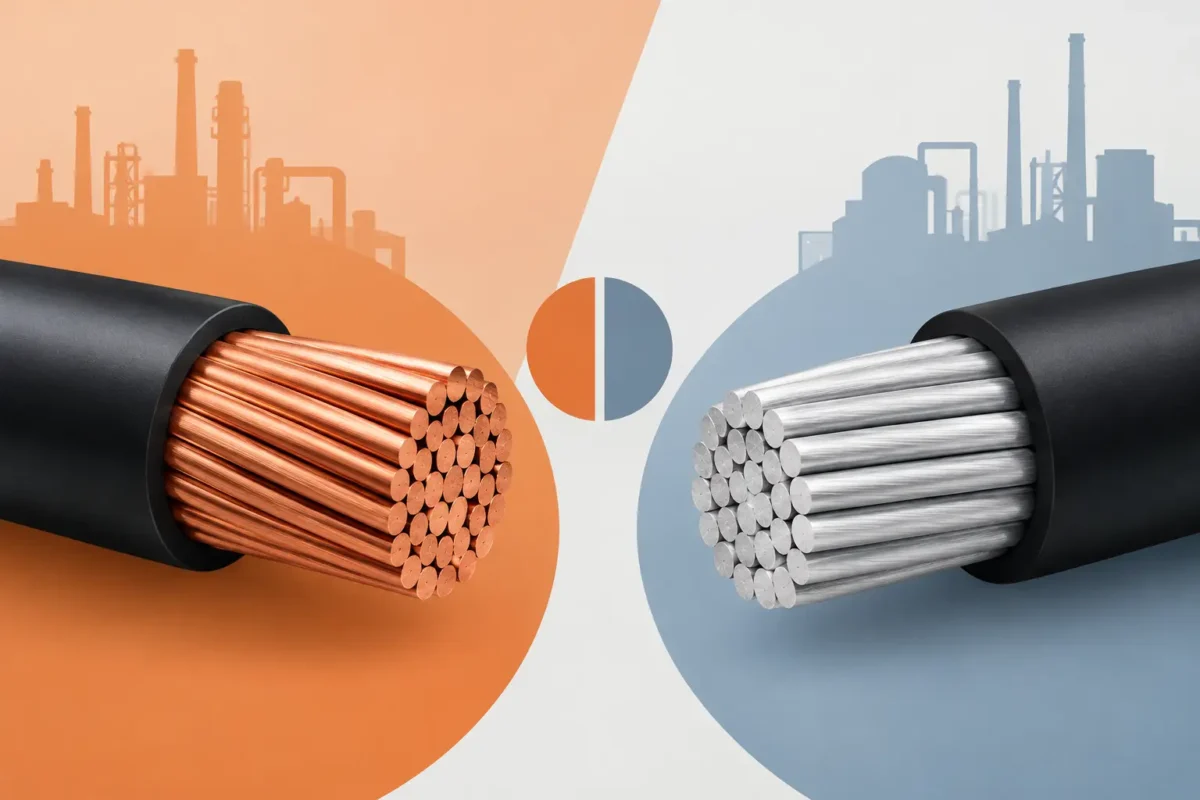
Copper has higher electrical conductivity. Under equivalent conditions, aluminum has approximately 61% of the conductivity of copper. This means that, to carry the same current with controlled voltage drop and heating, an aluminum conductor typically needs to have a larger cross-sectional area.
This difference directly affects the sizing. It is not appropriate to replace a copper cable with an aluminum one while maintaining the same nominal cross-section. The equivalence must be calculated according to the current carrying capacity, voltage drop, thermal limit of the insulation, ambient temperature, installation method, and circuit grouping.
In long feeders, voltage drop can be the determining factor. In short sections with high currents, thermal behavior and short-circuit capacity become more important. Therefore, selection requires design analysis, not a simplified gauge conversion.
Larger cross-section does not necessarily mean an unsuitable cable.
The need for a larger cross-section in aluminum increases the external volume of the cable and demands attention to the minimum bending radius, space in cable trays, cable glands, and panel occupancy. Even so, aluminum has a significantly lower density than copper. Even with a larger cross-section, the cable may have a lower total mass.
This characteristic is relevant in overhead lines, extensive feeder lines, large-scale infrastructure, and installations where weight influences transportation, launching, and mechanical support. In energy projects, this mass reduction can improve logistics and reduce stress on structures, provided that all accessories are compatible with the specified material and section.
Weight, flexibility and mechanical behavior
Copper combines high conductivity with good ductility. Therefore, it is widely used in cables for control, instrumentation, data, servomotors, robotics, and mobile applications. When constructed with appropriate stranding, it withstands repetitive bending with very consistent performance.
Aluminum is lighter, but its mechanical strength and bending behavior require more careful evaluation. In fixed circuits, correctly installed and terminated, it can be an efficient solution. However, in cable carriers, handling systems , vibratory equipment, reels, overhead cranes, and applications with intense bending cycles, copper tends to offer greater predictability of performance.
It's not just about the metal. The stranding class, the number of elementary wires, the cable geometry, the insulation, the outer sheath, and the defined bending radius for installation all make a difference. A special cable for continuous movement needs to be designed for continuous movement, not just chosen for its current-carrying capacity.
Connections: the critical point of aluminum conductors
Aluminum naturally forms a surface oxide layer. This layer has high electrical resistance and can compromise contact quality if preparation and termination are not adequate. Furthermore, the material is more susceptible to creep, that is, gradual deformation under mechanical pressure and thermal variation.
In practice, inadequate connections can result in increased contact resistance, localized heating, loosening, and premature failure. For this reason, aluminum cables require terminals, connectors, busbars, tightening torque, and assembly procedures specifically compatible with their application.
In copper-aluminum connections, the risk of galvanic corrosion must also be considered, especially in the presence of moisture, contaminants, or aggressive atmospheres. The use of bimetallic connectors or approved solutions for the transition between materials prevents the interface from becoming a point of failure in the system.
Copper also requires controlled assembly, but it usually exhibits greater tolerance in conventional industrial terminals. Even so, incorrect torque, inadequate crimping, incompatible terminals, or lack of inspection are frequent causes of failure, regardless of the conductor chosen.
Where copper is usually the safest technical choice.
In critical industrial automation and power applications, copper is often specified for its combination of smaller cross-section, higher conductivity, reliable connections, and superior performance under dynamic conditions. This is especially relevant for control cables , instrumentation, signaling, industrial communication, frequency inverters, servomotors, and embedded circuits.
It is also a common choice in naval, oil and gas, mining, railway, and installation environments with high vibration or exposure to harsh conditions. In these scenarios, the cost of the cable must be compared to the cost of an unscheduled shutdown, intervention in a restricted area, or a failure in a continuous process.
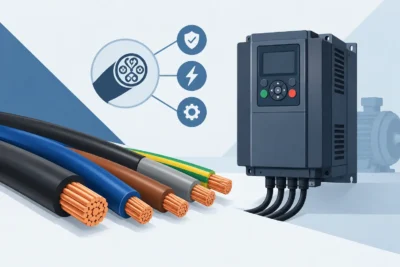
For circuits requiring electromagnetic shielding , copper construction offers practical advantages. The shielding must maintain electrical continuity and performance compatible with the system's frequency and sensitivity. In cables for inverters and servomotors, for example, the solution must control electromagnetic interference, withstand electrical stress, and preserve the integrity of the connected components.
Where can aluminum deliver the best technical-economic ratio?
Aluminum is a relevant alternative in large-section feeders, distribution networks, long-distance fixed installations, and projects where weight and total material cost reduction are strategic. Its use can be particularly advantageous when there is a high volume of conductor and infrastructure prepared to receive larger diameter cables.
For this advantage to materialize, the project must plan from the outset for the physical space, support, terminals, and commissioning procedures. Attempting to adapt a system designed for copper to aluminum only during the purchasing phase tends to shift costs to the field and increase the risk of non-conformities.
Economic analysis must also consider electrical losses throughout the cable's lifespan. An undersized cable may appear economical at the time of purchase, but it can generate thermal dissipation, voltage drop, and additional energy consumption for years. The correct decision compares the installed cost and the operational cost, not just the initial cost per meter.
Current capacity and short-circuit capacity are not isolated catalog values.
The ampacity reported in a table is conditioned by several factors. Soil or air temperature, installation method, number of grouped circuits, ventilation, burial depth, conduit type, and maximum conductor temperature all alter the result. The same cable can have very different permissible capacities in a ventilated tray, a closed cable tray, or an underground duct bank.
Short-circuit calculations also deserve attention. The conductor must withstand the thermal energy of the fault until the protection activates, without exceeding the limits of the material and insulation. The selectivity of the protection devices, the fault clearing time, and the presumed current at the point of installation are part of this verification.
Brazilian standards (ABNT and IEC) and specific project requirements establish criteria for these calculations and for cable construction. In regulated sectors or aggressive environments, there may also be requirements for low smoke emission, absence of halogens, fire resistance, resistance to oil, UV rays, water, abrasion, or chemicals. The conductor is only one part of the specification.
How to define the correct solution for each circuit.
A technically sound specification begins with the circuit's function: power supply, control, instrumentation, signal, motor power, or data transmission. Then, the voltage, operating current, starting current, length, permissible voltage drop, and short-circuit level must be evaluated.
Next, the installation and environmental conditions come into play: fixed or mobile, indoor or outdoor, presence of humidity, chemical agents, vibration, temperature, electromagnetic interference, and the need for fire resistance. Finally, the interface with the system needs to be validated, including terminals, connectors, cable glands, panels, cable trays, and assembly procedures.
It is equally important to avoid confusing solid or stranded aluminum cables with coated products or metallic combinations that do not serve the same electrical purpose. The conductor composition, its class, and certifications must be clearly identified in the technical documentation.
At Innovcable, the development of special cables stems precisely from this systems-oriented vision. When the application demands continuous performance, engineering must consider the conductor along with all the elements that determine the cable's service life in the field.
The best choice between copper and aluminum is the one that remains safe after installation, commissioning, and thousands of hours of operation. Specifying based on actual process conditions is the way to transform conductive material into operational reliability.