Learn how to select crane cables considering voltage, current, bending, environment, standards, and operation to reduce failures and critical downtime.
A cable failure in a crane rarely boils down to simply replacing a component. It can interrupt lifting operations, paralyze a production line, compromise team safety, and generate losses due to downtime. Therefore, understanding how to select crane cable requires going beyond the conductor's nominal cross-section or the lowest purchase price. The specification must reflect the real conditions of movement, electrical load, environment, and regulatory requirements of the operation.
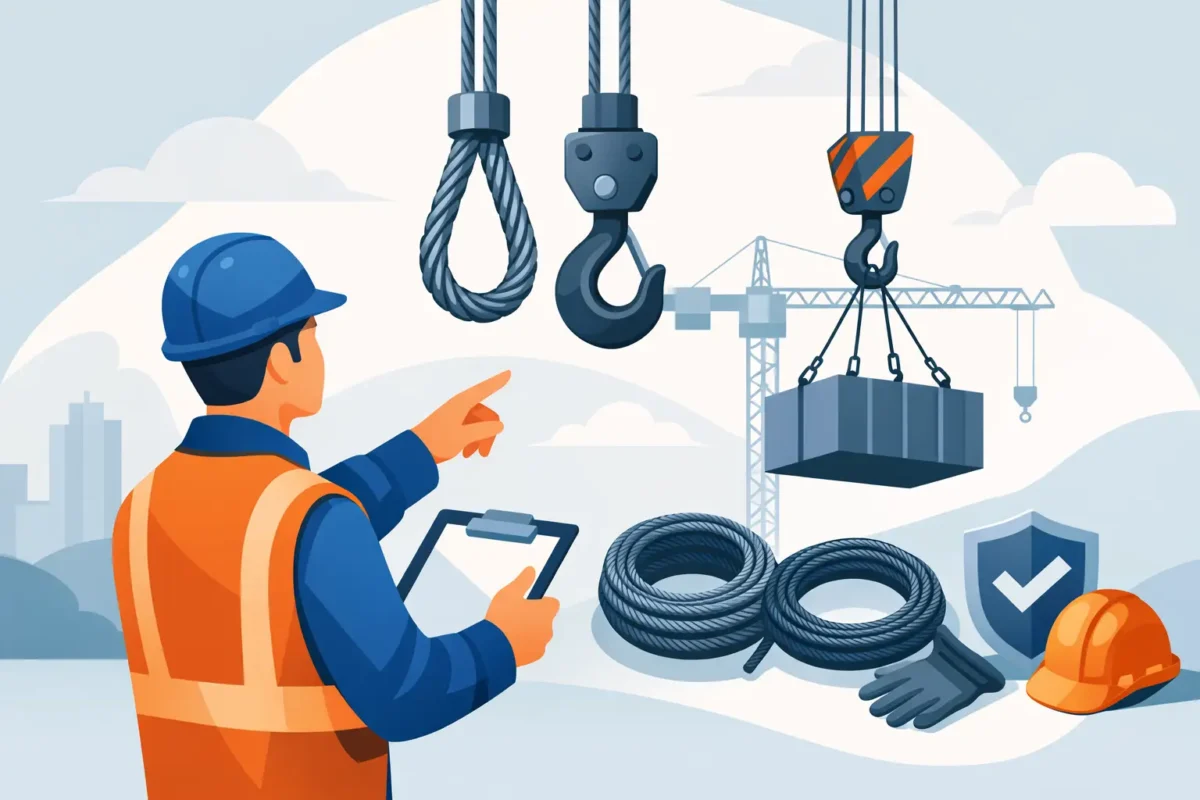
In this context, crane cable refers to the set of electrical cables intended for powering, controlling, instrumenting, communicating, or operating lifting equipment. It should not be confused with the steel cable used for lifting loads. Each system has its own design criteria, and in the case of electrical cables, flexibility and mechanical strength are as crucial as electrical performance.
Start with the crane's architecture.
The correct selection depends on where the cable will be installed and how it will move. A cable for a festoon crane is subject to different stresses than a cable wound on a drum, installed on a telescopic boom, or used in a port crane exposed to sea spray. Treating all these applications as equivalent is one of the most frequent causes of premature failures.
In festoon systems, the cable works in loops, with horizontal displacement and repetitive bending cycles. The design must consider the radius of curvature, translational speed, acceleration, distance between carriages, suspended weight, and the possibility of twisting. In winding systems, the requirements are even more stringent: the cable is subjected to tension, alternating bending, crushing between layers, and, in some cases, twisting during operation.
Before defining the construction, gather the equipment data: total stroke, travel speed, estimated number of cycles, drum or pulley diameter, installation height, fixing method, and presence of a drag chain , festoon, or winder. Without this information, the specification is based on assumptions and not on applied engineering.
Determine the electrical capacity without ignoring the installation.
The conductor cross-section must meet the design current, the permissible voltage drop, the installation method, and the thermal conditions. In cranes, it is common to have lifting, translation, and trolley motors, in addition to control, lighting, brake, sensor, and communication circuits. The demand is not simply the sum of the nominal loads, as simultaneity factors and starting peaks need to be evaluated.
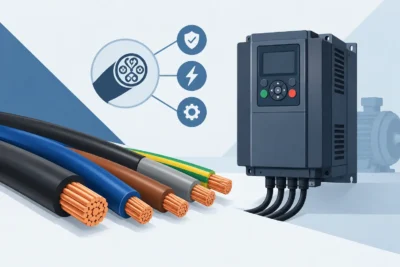
Motors controlled by frequency inverters deserve specific attention. These systems can generate high-frequency pulses, increase stress on insulation, and produce eddy currents. Depending on the architecture, the cable between the inverter and the motor may require shielding, an appropriately sized protective conductor, and construction prepared for electromagnetic compatibility.
Ambient temperature also alters conductivity. A cable installed near heat sources, outdoors under solar radiation, or grouped with other circuits may operate above the thermal conditions specified in the catalog. In these cases, applying only the standard ampacity creates an illusory safety margin.
Flexion, torsion, and tension define service life.
Mechanical performance is the central point in the selection of mobile cables. A common flexible cable may function in a static installation, but fail rapidly when subjected to thousands or millions of cycles in lifting equipment. The conductor construction, stranding, insulation material, filler type, and outer sheath must be compatible with the anticipated movement.
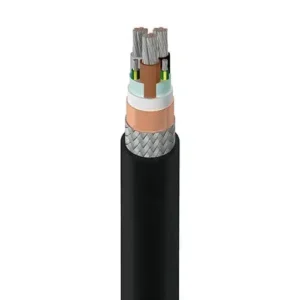
For continuous bending applications, look for cables developed with flexible copper conductors, internal elements that reduce friction, and a stable construction geometry. The sheath must resist abrasion and maintain its mechanical properties throughout its operational life. An excessively rigid sheath can limit mobility; a sheath that is too soft may not withstand dragging, impact, or crushing.
Allowable tensile strength should not be treated as a minor detail. In drum cables, especially in vertical or long runs, it may be necessary to use specific support elements, such as high-strength textile cords or reinforcements suitable for the construction. The electrical conductor should not alone bear mechanical stresses for which it was not designed.
The minimum bending radius must be respected from the installation stage. Undersized pulleys, sheaves, and drums concentrate stress, deform the internal structure of the cable, and accelerate the occurrence of filament breaks. Similarly, twists incorporated during assembly can compromise the cable's performance even before operation begins.
Assess environmental and chemical hazards.
The operating environment completely changes the specification. In steel mills, ports, mining, bulk terminals, pulp and paper, oil and gas, or chemical plants, the cable may face oil, grease, moisture, abrasive dust, salinity, ozone, UV radiation, high temperatures, and chemical agents. The choice of outer sheath should be based on these specific risks.
Cables with rubber compounds, for example, tend to offer high flexibility and good mechanical resistance in certain mobile applications. Thermoplastic sheaths, on the other hand, may be indicated when there are specific requirements for chemical resistance, low smoke emission, or suitability for a particular temperature range. There is no universally superior material: there is only the material best suited to the specific environmental impact profile of the installation.
In outdoor areas, resistance to UV rays and humidity must be documented. In naval, offshore, or port applications, exposure to salt spray and fire safety requirements may demand constructions aligned with industry standards, including IEC and NEK-606 references when applicable to the project. In classified areas, the analysis must integrate the requirements of the installation, the associated equipment, and the applicable standard.
Define shielding and control elements according to the system.
Modern cranes are heavily automated. Encoders, load cells, limit switches, sensors, industrial networks, and inverter drives coexist in the same equipment. Electromagnetic interference can lead to reading errors, intermittent communication failures, and unstable command behavior, often incorrectly interpreted as an electronic defect.
Power circuits and sensitive signals must be evaluated in an integrated manner. Shielded control cables may be necessary for certain analog signals, industrial communication, or inverter interconnection. However, shielding only delivers the expected result when the installation includes grounding and termination compatible with the system. Specifying a metallic braid without defining its application is transferring the problem to commissioning.
It is also necessary to decide whether the application requires multi-core cables, twisted pairs, identified control conductors, fiber optic elements, or hybrid combinations. In equipment with limited space, a customized solution can reduce the number of mobile cables, simplify assembly, and decrease potential points of failure.
Standards, traceability, and documentation are part of the selection process.
Compliance should not be verified only at the end of the purchase. The specification must indicate applicable standards, rated voltage, flexibility class, operating temperature, flame retardancy requirements, oil resistance, low smoke emission properties, and other critical characteristics. The technical documentation must allow validation that the supplied product meets the required performance.
For critical industrial operations, request construction data, applicable tests, batch identification, and quality criteria. The manufacturer's ISO 9001:2015 certification is a relevant management indicator, but it does not replace technical validation of the cable for that specific application. The best results come from a combination of quality system, product engineering, and understanding of the actual conditions of use.
How to select the least risky crane cable
The decision gains consistency when the technical buyer consolidates all variables before quoting. In addition to electrical and mechanical data, specify whether there is a frequency inverter, whether the cable will be installed on a drum or festoon, the available radius, the equipment speed, environmental exposure, and the expected lifespan. Photos, drawings, electrical diagrams, and a history of previous cable failures help identify limitations that do not appear in a generic description.
Avoid replacing one cable with another simply because they have the same number of conductors and cross-section. Two products with a similar appearance can behave very differently under bending cycles, tensile strength, abrasion, oil, and temperature. The lower initial cost may be offset by recurring replacements, emergency maintenance, and unproductive equipment hours.
Innovcable develops special cables for demanding industrial applications, including lifting and handling solutions that can be configured according to the project. When the crane operates in unconventional conditions, customization ceases to be a differentiator and becomes a feature of operational reliability.
The right cable isn't just the one that powers the crane on day one. It's the one that maintains predictable performance after thousands of cycles, withstands the work environment, and provides safety for an operation that can't stop.