Understand the criteria for offshore cables that define safety, durability, and performance on platforms, vessels, and critical maritime operations at sea.
An unscheduled shutdown on an offshore unit is not just a maintenance event. It can disrupt production, increase crew exposure to risks, and compromise complex logistical schedules. Therefore, offshore cable criteria must be defined before purchase, during the basic or detailed engineering phase, connecting the installation environment, electrical function, design standards, and maintenance strategy.
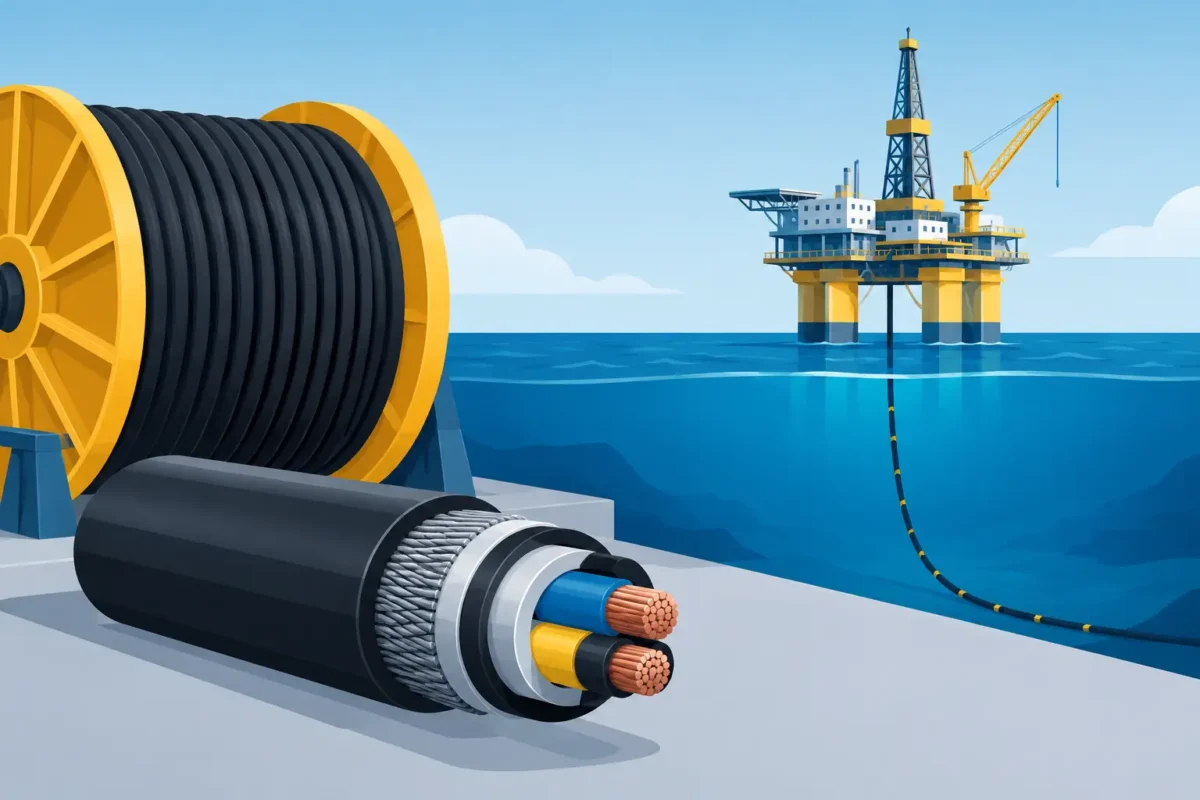
On platforms, support vessels, FPSOs, drilling units, and offshore processing plants, cable operates under a severe combination of salt spray, hydrocarbons, vibration, bending, heat, humidity, and eventual exposure to fire. A product suitable for an onshore industrial installation may fail prematurely when subjected to such conditions. The specification must be based on the actual application, not just the conductor's nominal cross-section or service voltage.
Criteria for offshore cables: start with the application.
The first definition is functional. Power, control, instrumentation, communication, alarm, fire detection, and emergency circuit cables have distinct requirements. Grouping all these functions under a single cable solution may seem convenient at the time of purchase, but it creates risks of electrical, mechanical, or regulatory incompatibility.
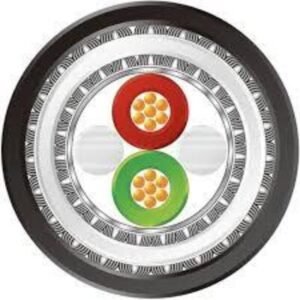
In instrumentation circuits , for example, signal stability depends on shielding, twisted pairs, capacitance, and electrical resistance appropriate to the system. In power cables, the analysis includes current carrying capacity, voltage drop, short-circuit conditions, and grouping conditions. Emergency systems may require maintaining circuit integrity for a defined period under the influence of fire.
It is also necessary to identify whether the cable will be installed in open areas, trays, cable ducts, conduits, watertight passages, classified areas, or zones subject to movement. A fixed circuit in a protected module does not face the same stress as a cable subjected to continuous equipment vibration, vessel movement, or bending in a dynamic application.
Marine environment is not a general requirement.
The saline atmosphere accelerates degradation processes in unsuitable materials. Moisture can penetrate poorly specified constructions, affecting insulation, shielding, and conductors over time. Oils, hydraulic fluids, fuels, and chemicals used in processes or maintenance should also be part of the compatibility analysis.
The choice of compounds for insulation and sheathing needs to consider temperature range, abrasion resistance, oil resistance, and behavior under solar radiation when installed outdoors. In certain routes, the cable may be subject to accumulated water, frequent washing, or splashes of chemicals. In these cases, it is not enough to request a "resistant" sheath: it is necessary to link the required performance to the agent present, the temperature, and the exposure time.
Mechanical construction also deserves attention. Armor, braiding, shielding, and reinforcing elements should be selected according to the risk of impact, crushing, traction, and rodents, when applicable. At the same time, increased protection may increase diameter, weight, and minimum bending radius. The best solution is the one that delivers the necessary protection without hindering launch, stowage, and maintenance on the planned route.
Fire safety and low emission requirements
In offshore environments, fire performance is one of the most critical aspects of the specification. An incident in a confined environment, with a high concentration of equipment and people, requires that the cable system helps to limit the spread of flames, smoke, and corrosive gases.
The requirements must clearly distinguish three needs: non-flame propagation, fire resistance, and circuit integrity. A cable that limits flame propagation is not automatically suitable for keeping a system energized during a fire. Similarly, a cable with low smoke and halogen gas emissions may be indispensable for evacuation routes and control rooms, but this does not replace integrity testing when the circuit's function is to keep pumps, alarms, emergency lighting, or critical communication operational.
Standards such as IEC 60332, IEC 60754, and IEC 61034 are frequently evaluated for flame propagation, acidity, and smoke emission. For applications involving circuit maintenance under fire, the design must specify the test method and the required time. Interpretation cannot be based solely on the cable's commercial code. It is necessary to verify the certificate, test report, and adherence to the installation's descriptive report.
Project standards, class, and documentation
The regulatory compliance of offshore cables typically combines international requirements, operator specifications, classification society requirements, and internal standards of EPC contractors or shipyards. Common references include IEC 60092 for electrical installations on ships and maritime units, as well as NEK 606 for projects that adopt practices from the North Sea offshore sector.
The standard indicated in the purchase document must be read together with its applicable parts, current edition, and supplementary requirements. A simple mention of a standard family does not, by itself, define sheathing material, voltage class, shielding, armor, fire behavior, or operating temperature. These parameters must be included in the technical data sheet.
Traceability is another engineering criterion. For each delivery, the responsible team must be able to verify product identification, batch, dimensions, manufacturing data, test results, and required certificates. In critical projects, the documentation must accompany the inspection and release flow, preventing discrepancies from being discovered only during the commissioning phase.
Electrical performance and electromagnetic compatibility
The conductor cross-section must be calculated considering the design current, ambient temperature, maximum conductor temperature, installation method, routing, and ventilation. In offshore environments, congested trays and confined sections can significantly reduce heat dissipation capacity. Specifying based on the equipment's rated current without applying correction factors is a recurring source of overheating.
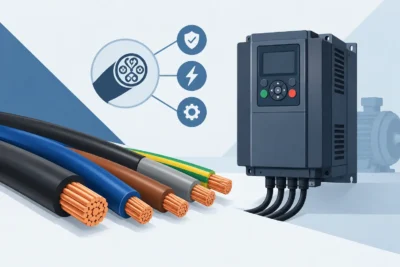
Voltage drop should also be evaluated in extensive circuits and sensitive loads. For motors, frequency inverters, and automation equipment, the analysis must include transients, harmonics, and electromagnetic compatibility. Cables for inverters, for example, may require shielding with adequate covering and a construction capable of withstanding peak voltages associated with electronic switching.
In analog signals, data, and instrumentation, the physical segregation between power and control routes is as relevant as cable shielding. The specification must define whether the shielding will be individual, collective, or combined, as well as the grounding method compatible with the system architecture. Correct shielding as specified in the catalog loses effectiveness when the installation disregards termination, continuity, and circuit separation.
Installation, maintenance and life cycle
The cable needs to be specified for safe installation. Minimum bending radius, maximum tensile strength, weight per meter, outside diameter, and compatibility with cable glands, connectors, and seals must be checked before supply. Changing the type of sheathing or adding armor after the infrastructure has been defined can lead to incompatibility with trays, conduits, supports, and space reservations.
It is also worth considering the maintenance strategy. On a difficult-to-access route, with high downtime costs or the need for maritime mobilization, the priority should be a predictable lifespan and resistance compatible with the most severe expected scenario. In a temporary installation, the criteria may change, as long as the solution continues to meet safety requirements and applicable standards.
Cost assessment should go beyond the price per meter. A cheaper cable, but one that is unsuitable for temperature, bending, or chemical exposure, can transfer costs to operations in the form of premature replacement, signal failure, downtime, and rework. The most useful parameter is the total cost over the lifecycle, associated with the operational risk that the route represents.
Applied engineering for reliable specifications
A consistent offshore specification brings together process, electrical, mechanical, installation, and compliance data. The technical sheet should indicate circuit function, voltage, number and cross-section of conductors, conductor class, insulation, sheathing, shielding, armor, fire requirements, temperature, chemical resistance, standards, certifications, and acceptance tests. The more critical the circuit, the smaller the margin should be for generic fields or decisions made solely based on commercial equivalence.
Innovcable uses applied engineering and on-demand manufacturing to transform these requirements into special cable solutions tailored to the application conditions. This allows for customized construction, materials, and documentation to fit the project, rather than forcing a critical application to conform to an off-the-shelf product.
In offshore operations, the cable ceases to be a passive component when continuity depends on it. Proper specification means deciding, before installation, how the system will respond to salt, heat, vibration, fire, and time.