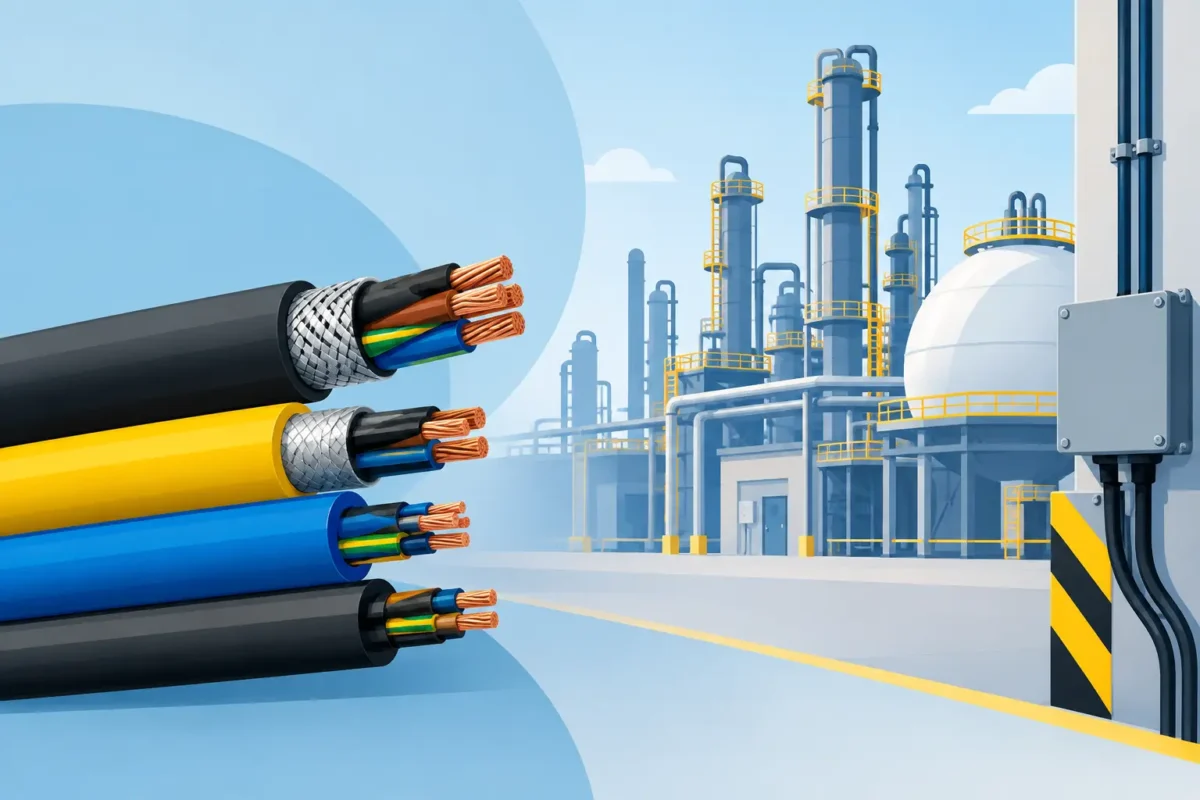
Cable management guidelines for classified areas: criteria for specifying cables, cable glands, and installation with safety, compliance, and continuous industrial performance.
A failure in the instrumentation circuit within a process unit can halt an operation, compromise critical measurements, and pave the way for high-risk interventions. This guide to cables for classified areas starts from an essential premise: the cable is not an isolated item on the bill of materials. It is part of the ignition protection system and needs to be defined according to the area classification, the type of circuit, the installation method, and the actual operating conditions.
In oil and gas, chemical, mining, fuel storage, grain, or paint facilities, selection cannot be limited to nominal voltage and conductor cross-section. Combustible gases, vapors, mists, and dusts require an integrated assessment involving electrical engineering, process safety, assembly, and maintenance. Correct specification reduces downtime, avoids inspection incompatibilities, and preserves system integrity throughout its service life.
What defines a classified area?
A classified area is a location where an explosive atmosphere may exist in sufficient quantity to require special design, installation, and maintenance measures. The classification identifies the probability and duration of the presence of this atmosphere, but it does not replace the analysis of release sources, ventilation, and the characteristics of the processed product.
For gases, vapors, and mists, the zones typically adopted are Zone 0, Zone 1, and Zone 2. Zone 0 indicates continuous, frequent presence or presence for long periods; Zone 1 corresponds to probable occurrence in normal operation; and Zone 2 represents a condition not expected in normal operation or present only for a short time.
For combustible dusts, the logic applies to Zones 20, 21, and 22. In these environments, dust deposits, inadequate cleaning, surface temperature, and cable entry seals can be as relevant as the electrical hazard of the circuit. A system suitable for gas should not automatically be considered suitable for dust.
In Brazil, the classification definition and installation must consider, among other references applicable to the project, the ABNT NBR IEC 60079 series. Parts 10-1 and 10-2 deal with the classification of areas with gas and dust, respectively, while ABNT NBR IEC 60079-14 guides the selection and installation of electrical equipment. The project classification report and the client's requirements are the documents that transform the standard into an engineering criterion for each point of the plant.
Cable guide for classified areas: start with the circuit
The initial question isn't simply "which cable supports this area?". The correct question is: what function does this circuit perform, where does it run, what equipment does it serve, and what faults need to be avoided?
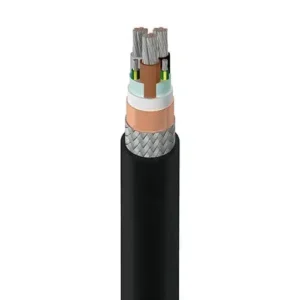
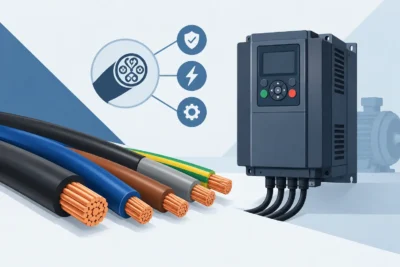
Power, control, instrumentation, communication, and safety circuits have different requirements. An instrumentation cable, for example, may require twisted pairs or triples, individual and collective shielding , low capacitance, and precise identification to protect 4-20 mA signals, thermocouples, or digital communication. A motor circuit, on the other hand, may require higher current capacity, mechanical protection, and electromagnetic behavior compatible with frequency inverters.
It is also necessary to define whether the cable feeds equipment installed within the classified area or if it merely crosses that area via cable trays, conduits, or underground installation. The route modifies the mechanical, chemical, and thermal stresses. On an offshore platform, for example, salt spray, vibration, hydrocarbons, and weight restrictions may dictate the choice of constructions and materials different from those used in an onshore tank area.
The cable, by itself, does not necessarily receive an Ex marking equivalent to that of an enclosure or luminaire. The conformity of the assembly depends on the compatibility between the cable, equipment, protection method, cable gland, adapters, caps, junction boxes, and installation method. Treating these elements as independent purchases is a recurring source of non-conformities in the field.
Technical criteria for specifying the cable
The cable construction must respond to service conditions, not just the initial design conditions. Ambient temperature, conductor temperature, sun exposure, presence of oil, chemicals, abrasion, movement, and impact risk directly influence the service life of the insulation and sheathing.
The conductor cross-section needs to be sized based on current carrying capacity, voltage drop, short-circuit potential, and starting criteria, when applicable. In extensive circuits, voltage drop can compromise drives, solenoid valves, and instruments even when the rated current seems adequate. For data and instrumentation cables, impedance, capacitance, electrical resistance, and immunity to interference are also factors to consider.
Shielding deserves special attention. It can reduce noise induced by motors, contactors, and inverters, but it only delivers the expected result when the grounding strategy is defined for the system architecture. Grounding at one or both ends depends on the signal type, frequency, and electromagnetic compatibility study. There is no single rule that applies to all circuits.
The external covering must be selected according to the environment. Compounds resistant to oil and hydrocarbons are common in certain process areas; materials with low smoke and corrosive gas emissions may be required in escape routes, control rooms, or naval installations; and rubber coverings may be suitable when there is bending, impact, or mechanical severity. Each choice involves trade-offs between flexibility, chemical resistance, thermal range, outside diameter, and installation cost.
When there is a risk of mechanical damage , protection may require reinforcement, conduit, or a reinforced route. Reinforcement is not an automatic solution: it increases mass, rigidity, and minimum bending radius, and may be unsuitable for mobile sections or areas with high cable density. The design must also define the electrical continuity of the metallic protection and the corresponding grounding system.
Cable glands: the point where the specification usually fails.
Even a correctly selected cable can lose its suitability due to improper termination. The cable gland must be compatible with the Ex protection type of the equipment, the zone, the gas or dust group, the temperature range, the required degree of protection, and the actual cable diameter.
In explosion-proof enclosures, for example, the cable entry method must meet the enclosure certification and applicable installation rules. Depending on the cable construction, the presence of fillers, and the equipment requirements, barrier or sealing systems may be necessary. It is unacceptable to assume that any metal cable gland meets any Ex enclosure requirements.
The tightening should also follow the torque indicated by the manufacturer. Insufficient tightening compromises sealing and mechanical retention; excessive tightening can deform the cover, damage the insulation, or reduce the seal over time. In dusty areas, this seal becomes even more important, as the accumulation of particles can affect the degree of protection and increase thermal risks.
Installation and segregation preserve performance.
Even the best specifications lose value if the installation causes damage. Respecting minimum bending radius, maximum tensile strength, and conduit occupancy rate prevents deformations that are not always visible after assembly. In shielded cables, sharp bends and crushing can alter the internal geometry and degrade sensitive signals.
The segregation between power, control, instrumentation, and communication should be planned based on energy levels, available routes, and signal criticality. The proximity of cables for inverter-driven motors, for example, may require physical separation, metal barriers, or cables with specific construction. The solution depends on the electromagnetic arrangement of the installation and not just the distance between cable trays.
In crossings, junction boxes, and panel entrances, identification must remain legible and consistent with diagrams, cable lists, and datasheets. This reduces diagnostic time and limits unnecessary interventions in hazardous areas. For critical projects, recording torque, insulation tests, shielding continuity, and visual inspections creates useful traceability for commissioning and maintenance.
A practical check before purchase.
Before authorizing manufacturing or acquisition, engineering must consolidate at least five definitions:
- Zone, group, temperature class and characteristics of the explosive atmosphere;
- Circuit function, voltage, current, signal, voltage drop, and electromagnetic compatibility requirements;
- Installation route, environmental exposure, mechanical stress, and bending requirements;
- requirements for flame propagation, fire resistance, low smoke emission, or chemical resistance;
- Documented compatibility between cable, cable glands, enclosures, accessories, and grounding method.
There is a difference between resistance to flame propagation and circuit integrity in a fire. A cable that limits flame propagation does not necessarily keep the circuit operating under fire. Detection, alarm , emergency lighting, and fire suppression control systems may require additional fire survival criteria, defined by the safety design.
For special applications, custom manufacturing can simplify the solution. Innovcable develops special cables for harsh conditions, allowing for adjustments to construction, shielding, sheathing, and performance requirements to the environment and installation method. This approach is particularly useful when imported specifications do not meet deadlines, dimensions, or local operating conditions.
In classified areas, reliability is not achieved through a generic catalog selection. It arises from the compatibility between classification, circuit, cable construction, certified accessories, and installation discipline. When these elements are treated as a single engineering system, operation gains predictability precisely where a failure cannot be treated as routine.