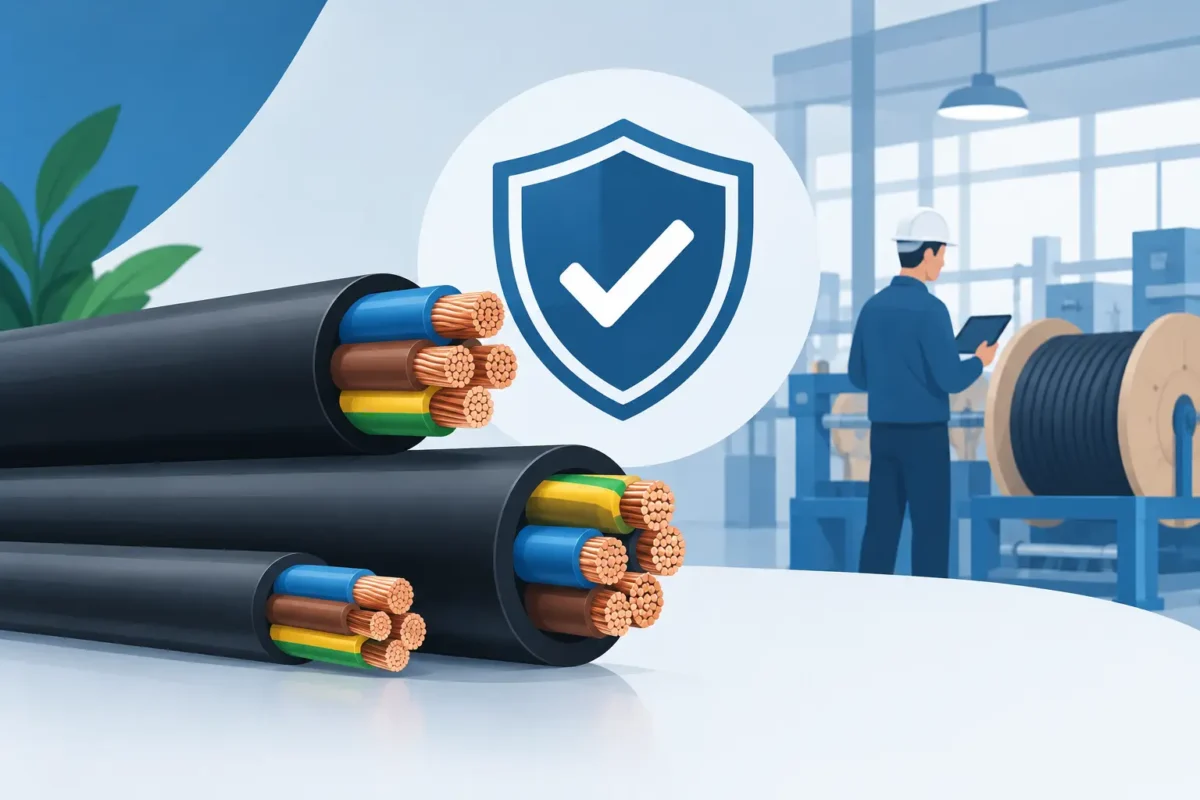
ISO 9001 certification for cables ensures controlled processes, traceability, and quality for critical industrial projects, from development to safe delivery.
A failure in an instrumentation cable, a continuous motion harness, or a medium-voltage power supply rarely begins at the time of installation. It can originate from incomplete project definition, inadequate raw material replacement, or the absence of controls between stages. This is where ISO 9001 for cables becomes relevant: it structures the quality management system that supports the manufacturing, documentation, and continuous improvement of products intended for critical applications.
For those who specify, purchase, or integrate industrial cables, a manufacturer's ISO 9001:2015 certification should not be interpreted as a generic seal. It is evidence that there are defined processes to transform engineering requirements into repeatable, traceable products that are evaluated before shipment. This reduces uncertainties, especially when the cable needs to withstand bending, oil, abrasion, temperature, electromagnetic interference, flame, or external exposure.
What does ISO 9001 for cables really prove?
ISO 9001 is a quality management system standard. In other words, it does not, in isolation, certify that a cable meets a specific voltage, fire class, shielding rating, or construction standard. These requirements are addressed by project specifications and applicable standards, such as ABNT, IEC, NEK-606, UL, NBR, or industry standards.
The role of ISO 9001 is to ensure that the organization has a method for identifying these requirements, controlling the production steps, and verifying that the delivered result corresponds to what was agreed upon. In a special cable factory, this involves everything from the critical analysis of the commercial request to the release of the finished product.
The difference is crucial. A cable may be technically well-designed on paper, but lose performance if there is uncontrolled variation in insulation extrusion, shielding application, conductor formation, or conductor identification. A certified quality system establishes criteria to prevent this type of deviation and address occurrences when they arise.
It is also necessary to distinguish between certification and technical capability. ISO 9001 does not replace the electrical, mechanical, and environmental tests required for an application. It creates the management conditions for these tests to be planned, executed, recorded, and used in decision-making. For a technical buyer, the value lies in the combination of a quality system, applied engineering, and compliance with the specific requirements of the cable.
From specification to batch: where quality is built
The quality of an industrial cable is not limited to the final inspection. When control only begins at the end of the line, the manufacturer may detect a nonconformity, but will have less ability to prevent waste, delays, and recurrence of the problem. ISO 9001 guides a process-oriented approach, with responsibilities and evidence distributed throughout the production cycle.
Critical analysis of the technical requirement.
The first check is in interpreting the demand. It is necessary to confirm data such as nominal voltage, current, number and cross-section of conductors, flexibility class, minimum bending radius, operating temperature, type of installation, chemical resistance, need for shielding , and reference standards.
In automation projects , for example, a cable for a cable carrier cannot be treated as a static control cable. In naval applications , fire behavior, low smoke emission, and installation requirements can completely alter the design. Critical analysis prevents a simplified commercial description from being transformed into a product unsuitable for the real environment.
Materials and supplier control
Copper, insulating compounds, sheathing materials, tapes, shielding, and reinforcing elements directly influence final performance. A quality management system requires criteria for approving suppliers, receiving materials, identifying batches, and evaluating deviations.
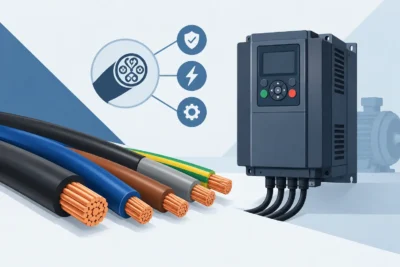
This discipline is especially relevant in rubber cables, servomotors, frequency inverters, and outdoor installations, where formulation and composition affect flexibility, oil resistance, thermal stability, UV protection, and service life. It's not enough for the material to have the correct name; it needs to meet the parameters defined for that specific construction.
Standardization of manufacturing
Repeatability depends on controlled parameters in processes such as wire drawing, stranding, insulation, assembly, shielding, coating, and identification. Work instructions, validated settings, and in-process inspections help maintain dimensions, concentricity, adhesion, and finish within established limits.
In practice, this means that a process change should not occur informally. When an adjustment, component replacement, or constructive improvement is needed, the change must be analyzed for its impact on the customer's requirements. This control protects both the integrity of the project and the continuity of supply.
Testing, inspection and release
Before shipment, the results must demonstrate that the batch meets the defined acceptance criteria. Depending on the product and application, tests may include electrical continuity, conductor resistance, applied voltage, insulation resistance, dimensional verification, visual inspection, marking evaluation, and other tests specified in the specifications.
Final inspection does not eliminate the need for control during manufacturing, but it confirms the conformity of the released product. For the customer, the key point is to receive documentation consistent with the order and information that allows them to identify the material supplied.
Traceability reduces risk in critical applications.
When a question arises in the field, the ability to trace the cable ceases to be an administrative item and becomes an engineering tool. Lot identification allows retrieval of information about the production order, materials used, inspection records, test results, and manufacturing conditions.
This is particularly relevant in sectors such as oil and gas, mining, power generation, rail, airports, and shipbuilding, where unscheduled shutdowns can lead to safety risks, production losses, and high maintenance costs. Traceability accelerates technical investigations and allows for corrective actions to be defined based on evidence, not assumptions.
It also facilitates asset management. By registering the installed cable by area, circuit, or equipment, the maintenance team can track failure history, operating conditions, and expected lifespan. In large installations, this organization reduces the time needed to locate information during an intervention.
How to evaluate a certified manufacturer
The presence of ISO 9001 certification is a good starting point, but the purchasing decision should consider how the quality system is implemented in operation. A supplier prepared for special applications can discuss requirements objectively, present technical limitations, and document engineering decisions.
In the evaluation, it is worth noting whether the manufacturer can detail the proposed construction, indicate applicable standards, establish an inspection plan, and identify the production batch. It is also relevant to verify their ability to fulfill on-demand projects, as process standardization does not mean offerings restricted to catalog items. In the case of special cables, quality also means translating an unconventional need into a manufacturable and verifiable solution.
Another key point is the handling of non-conformities. No industrial process is immune to deviations. The difference lies in the speed with which the cause is identified, the impact is contained, transparent communication is achieved, and actions are implemented to prevent recurrence. ISO 9001 establishes a foundation for this learning cycle.
Innovcable applies this vision of quality to the manufacture of cables for demanding environments, connecting engineering, production controls, and the specific requirements of each project. For critical applications, this alignment reduces the risk of specifying solely based on price or immediate availability.
Certification does not eliminate the need for proper specification.
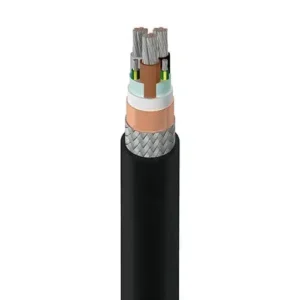
A common mistake is to assume that ISO 9001 alone resolves all cable selection decisions. It doesn't define whether the cable needs a tinned conductor, special compound sheathing, copper shielding, armor, low capacitance, or specific fire behavior. These choices depend on the application, the environment, and contractual standards.
Therefore, the best choice combines clear technical specifications with a manufacturer that has proven quality management. The more demanding the environment, the more relevant it is to disclose real usage conditions: presence of oil, humidity, chemical agents, movement, sun exposure, extreme temperatures, risk of interference, and safety requirements.
ISO 9001 certification for cables creates confidence in the process, but field performance stems from the combination of correct requirements, appropriate design, and controlled manufacturing. When these three elements work together, the cable ceases to be merely a connecting component and becomes essential for protecting the operational continuity of the system.