Discover the best cables for electrical panels and choose reliable conductors for control, power, and signal in critical industrial applications.
A panel can be correctly sized and still have faults due to an inadequate choice of conductors. Overheating at terminals, interference in analog signals, breaks during assembly, and shutdowns due to short circuits often begin inside the enclosure. Therefore, defining the best cables for electrical panels requires evaluating more than just the nominal cross-section or the price per meter.
In industrial applications, the cable must meet the electrical design, the installation environment, and the required level of operational continuity. A motor control center, an automation panel for a production line, and a distribution board have distinct needs. Efficient specification considers current, voltage, temperature, flexibility, regulatory compliance, fire behavior, and signal integrity.
Best cables for electrical panels: the choice depends on the function.
There is no single product that is best for all internal connections in a panel. The selection begins with the function of the circuit. Power cables conduct energy to circuit breakers, contactors, inverters, and loads. Control cables interconnect pushbuttons, relays, discrete sensors, and safety elements. Instrumentation and communication circuits require additional protection against electromagnetic noise.
Mixing these requirements into a generic specification is a frequent source of problems. A suitable conductor for powering a motor may not preserve the stability of a 4-20 mA signal. Similarly, a shielded cable for instrumentation may be technically unnecessary and increase the cost of a simple control connection.
Engineering should define each cable family based on the electrical diagram, design currents, installation methods, circuit segregation, and machine or process requirements. This analysis reduces rework during assembly and provides predictability for future maintenance.
Flexible cables for power and internal distribution.
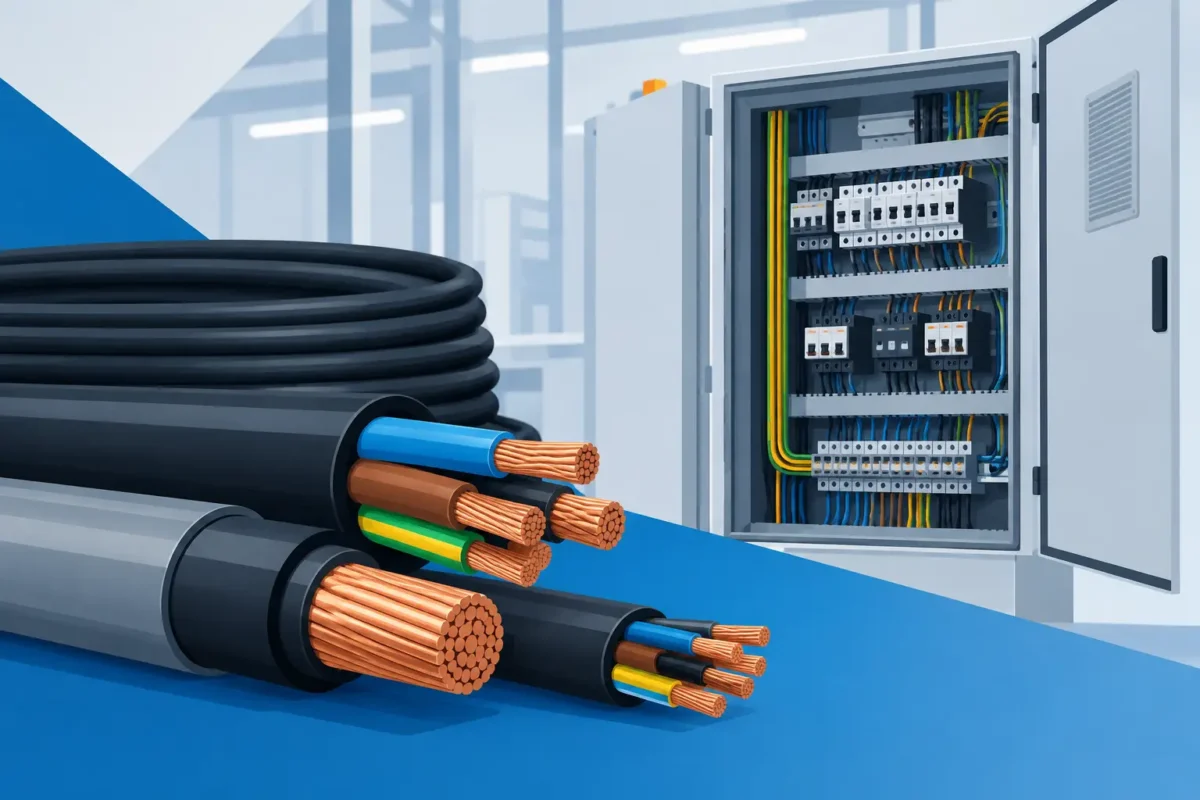
For internal power circuits, flexible copper conductors are widely used due to their ease of mounting in conduits, bends, and terminals. The stranding class directly influences flexibility and behavior during installation. In panels with high component density, a less flexible cable increases bending stress, occupies more usable space, and can transmit mechanical stress to the terminals.
The conductor cross-section should not be defined solely by the nominal load current. It is necessary to verify the current-carrying capacity under real conditions, including circuit grouping, internal panel temperature, ventilation, voltage drop, and characteristics of the protection devices. The sizing must also consider the short-circuit withstand capability until the protection trips.
In applications operating at high temperatures, conductors with insulation for a higher thermal class can offer a significant operational margin. However, this does not eliminate the need to control the heating of the assembly. Busbars, connection points, tightening torque, ventilation, and the physical layout of the panel all have a direct impact on the insulation's lifespan.
Control cables for automation and machinery.
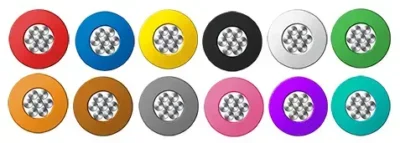
Control circuits require flexible, identifiable cables compatible with the system voltage. Color-coded identification, numbering, ferrules, and up-to-date documentation are not merely a finishing detail. They reduce commissioning time, prevent errors during interventions, and make panel traceability more reliable.
In machines with vibration, moving doors, or sections subject to recurring movement, mechanical resistance must be included in the specification. A cable installed in a fixed conduit does not face the same stress as a harness connected to a panel door or a connection near vibrating equipment. In these cases, the minimum bending radius and the ability to withstand bending must be verified in the design.
It is also important to note the compatibility between the cable insulation and the panel elements. Cable trays, clamps, cable glands, and terminals must not cut, crush, or subject the conductor to tension. A well-executed assembly preserves the cable geometry and prevents failures that only appear after months of operation.
Armor: when it ceases to be optional
Instrumentation signals, encoders, industrial communication, and low-voltage control circuits can suffer interference generated by motors, contactors, transformers, and especially frequency inverters. Reading fluctuations, intermittent communication failures, and incorrect commands are symptoms that do not always originate in the PLC or the instrument. Often, the problem lies in the cabling architecture.
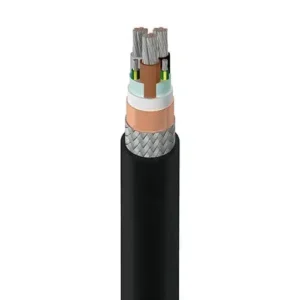
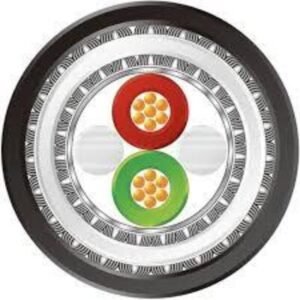
Shielded cables help control noise coupling, provided they are applied judiciously. The shielding must have coverage and construction appropriate to the type of interference expected, and its termination must follow the grounding philosophy defined by the project. An interrupted, poorly connected, or improperly grounded shield can reduce its efficiency or create unwanted paths for parasitic currents.
Physical segregation is equally crucial. Power and signal cables should not share the same route without technical analysis. When crossing is unavoidable, running them at an angle close to 90 degrees tends to reduce coupling compared to long parallel runs. In compact panels, metal partitions and separate conduits can be an essential part of the solution.
Frequency inverters require specific cables.
The output of a frequency inverter does not behave like a conventional motor power supply. The high-frequency pulses and high voltage change rates can generate additional stress on the insulation, common-mode currents, electromagnetic interference, and voltage in the motor bearings.
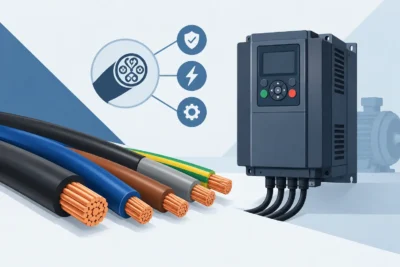
For this reason, the section between the inverter and the motor should be evaluated as a separate application. Depending on the power, distance, switching frequency, and the drive manufacturer's recommendations, appropriately shielded inverter cables, a properly sized protective conductor, and a construction focused on emissions control may be necessary. Low-impedance grounding and correct shield termination are part of the overall performance, not secondary installation steps.
Inside the panel, separation between input, inverter output, and sensitive circuits reduces noise propagation. Filters, reactors, and component layout complement the cable selection. Specifying only a common power cable for the entire architecture may seem economical at first, but it increases exposure to time-consuming diagnostics and downtime that is difficult to reproduce.
Safety, fire and regulatory compliance
The behavior of the cable in a fire situation must comply with the installation requirements and the criticality of the process. In certain projects, materials with low smoke and corrosive gas emissions are necessary to reduce risks to people, equipment, and control systems. In others, continued operation during a fire may be a requirement for essential circuits such as detection, alarm, emergency lighting, or safety functions.
Compliance must be analyzed based on the scope of the panel and installation. References such as ABNT NBR 5410, ABNT NBR IEC 60204-1, and ABNT NBR IEC 61439 guide relevant decisions, but do not replace the electrical design or the specific requirements of the client, insurer, or industrial sector. For machines exported or integrated with international standards, there may be additional certification, identification, and construction requirements.
Complete technical documentation should also accompany the purchase. Technical data sheet, insulation voltage, thermal class, conductor composition, bending radius, applicable standards, and batch traceability allow you to validate whether the material received corresponds to what was specified. In an engineering environment, relying solely on a short commercial description is an unnecessary risk.
How to finalize the specification without compromising the assembly.
Before purchasing, it's worth consolidating the information that truly guides the choice: circuit function, current and voltage, calculated cross-section, flexibility class, expected temperature, presence of oil or chemical agents, shielding requirements, fire resistance requirements, and regulatory standards. With this data, the comparison is no longer based on appearance or unit cost, but on performance throughout its service life.
It is also recommended to standardize cable families whenever possible. This practice simplifies inventory, assembly training, identification, and maintenance. However, standardization should not force the same cable into incompatible functions. Critical projects require well-justified exceptions, especially in sensitive signals, inverter outputs, and circuits subject to temperature or movement.
Innovcable operates in this area with its own manufacturing and applied engineering for control, instrumentation, power, automation, and special applications. When the usage conditions deviate from the standard, the solution needs to be developed specifically for the process, not adapted in an improvised way from the available catalog.
The best cable for an electrical panel is one that maintains its electrical, mechanical, and safety functions under actual operating conditions. Specifying with this criterion transforms the internal cabling from an invisible component into an effective layer of reliability for the entire installation.