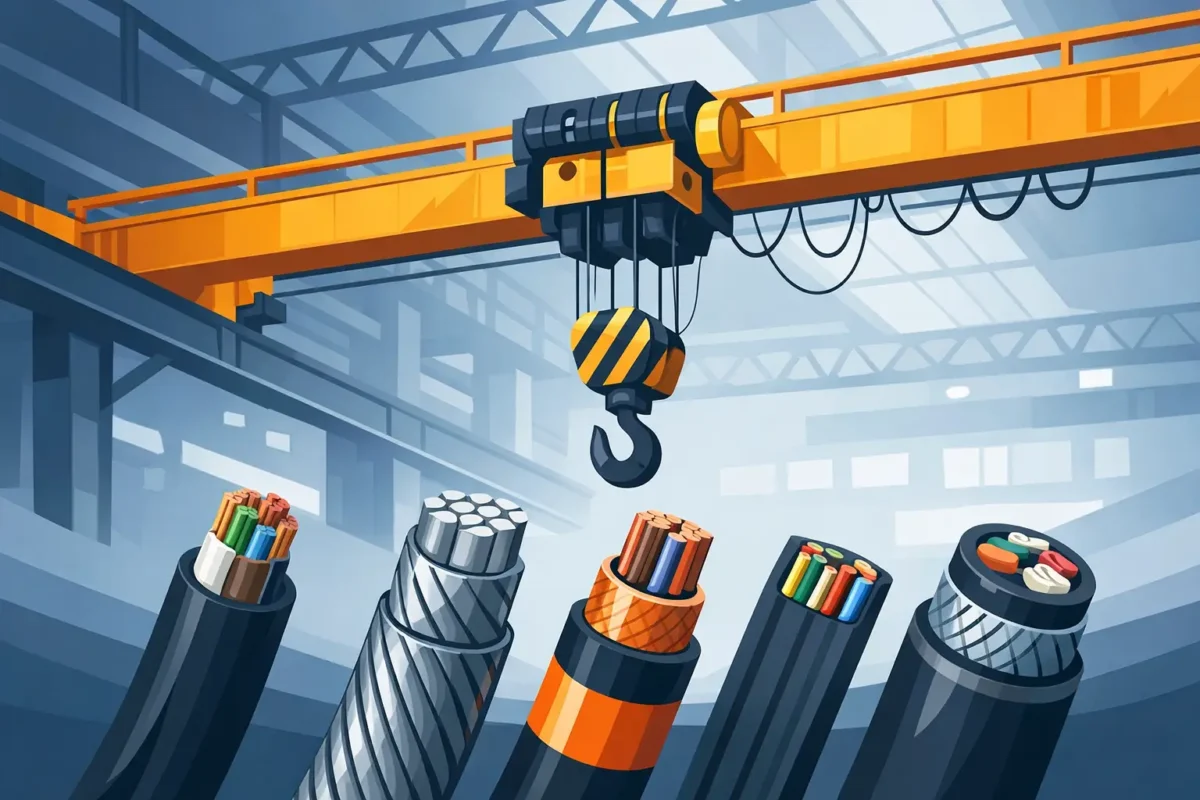
Discover the best cables for overhead cranes and engineering criteria that prevent downtime, bending failures, and risks in the handling of real loads.
An overhead crane can have a mechanical structure designed for years of operation and still suffer recurring breakdowns due to a seemingly simple component: the cable. Choosing the best cables for overhead cranes doesn't just mean selecting a product with a larger cross-section or thicker sheath. The decision needs to consider the handling system, the bending regime, the speed, the environment, and the consequences of a failure during load transport.
In steelmaking, port, mining, pulp and paper, heavy manufacturing, or distribution center operations, an incompatible cable can lead to conductor breaks, sheath cracks, insulation loss, and intermittent control failures. The result is corrective maintenance, equipment downtime, and increased operational risk. Correct specification begins with the actual application, not a generic description of flexible cable.
What defines the best cables for overhead cranes?
The best cable is one designed to withstand, repeatedly and predictably, the electrical and mechanical demands of the equipment. In an overhead crane, the conductor follows longitudinal, transverse, or vertical movements, and can operate in festoon systems, motorized reels, drums, cable carriers, or pendant controls.
Each configuration generates different stresses. In a festoon system , the cable works in successive curves and is exposed to tension between the cars. In a reel, it faces continuous winding and unwinding cycles, as well as alternating bending and, in certain cases, torsion. In the hook hoisting cable, the suspended weight, acceleration, and lifting height directly influence the design.
Therefore, the analysis must go beyond the nominal voltage. A cable for powering motors, for example, will not necessarily have the same construction as that indicated for control signals, communication, instrumentation, or circuits with frequency inverters. The best solution usually combines specific lines in the same equipment, each sized for its function.
Electrical and mechanical construction: where service life is decided.
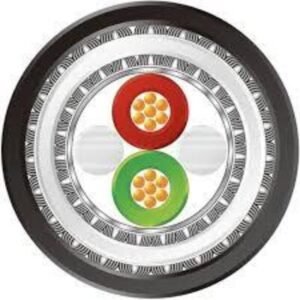
Durability in motion depends primarily on the internal construction. Flexible copper conductors, with stranding suitable for dynamic applications, reduce stress concentration in each bending cycle. The flexibility class must be evaluated in conjunction with the minimum bending radius and the expected number of cycles, as apparent flexibility does not guarantee performance in continuous service.
Insulation and external covering also need to be suited to the installation environment. Rubber compounds are often recommended when high flexibility, mechanical strength, and good performance in mobile applications are required. Polyurethane coverings can be an efficient alternative in cases of intense abrasion, dragging, contact with oils, and high tear resistance requirements. However, environments with heat, humidity, chemical agents, solar radiation, or low temperatures require a composition specifically designed for those conditions.
Another critical point is the support element. In cables subjected to vertical tension or significant drag forces, the load should not be absorbed exclusively by the electrical conductors. Depending on the design, textile elements or reinforcing components can be incorporated into the construction to withstand the mechanical stress. The choice, however, depends on the cable weight, the run, the speed, and the fastening system.
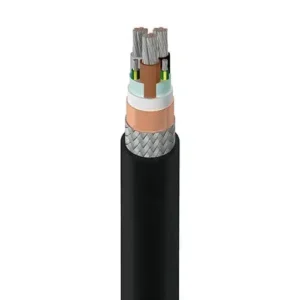
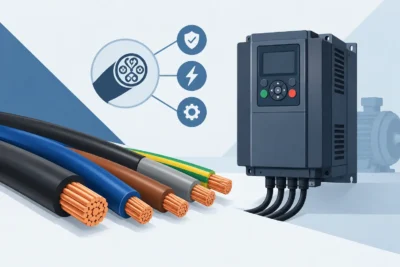
For power applications, it is necessary to verify current carrying capacity, voltage drop, motor starting, and operating temperature. In systems with frequency inverters, the presence of high-frequency pulses and reflected voltages may require specific cables with shielding and construction solutions that reduce electromagnetic interference and contribute to circuit integrity.
Shielding and interference control
Modern overhead cranes house inverters, PLCs, sensors, encoders, industrial networks, and remote controls. When power and signal cables share routes or operate near sources of electromagnetic noise, interference can cause reading errors, loss of communication, and unstable drives.
Shielded control cables , shielded instrumentation, and cables suitable for servo drives must be evaluated according to the electrical architecture. The shielding needs to have coverage and continuity compatible with the expected interference level, but its effectiveness also depends on grounding, physical segregation of circuits, and installation. It is pointless to specify a technically correct cable and then install the shielding improperly in the panel or equipment.
How to choose cables for each motion system
The specification gains precision when the system is treated as part of the project. For overhead cranes with festooning, the following must be specified: travel length, span between supports, travel speed, number of trolleys, linear cable weight, and curve radius. Cables that are too heavy or have an incompatible bending radius increase the stress on the assembly and accelerate wear.
In winding drums, attention is focused on the drum geometry, the number of winding layers, the entry angle, the tension, and the duty cycle. A cable intended only for bending on a conveyor belt should not be automatically applied to winding. The deformation caused by the overlapping layers and the tension requires specific validation.
For pendant pushbuttons, in addition to flexibility, tensile strength, the behavior of the casing during handling, and the organization of the control leads are relevant. In circuits with emergency stops, interlocks, or safety controls, conductor identification and electrical integrity must comply with the equipment design and applicable standards.
A complete technical request should include, at a minimum, the following information:
- Voltage and current in power, control, and signal circuits;
- Type of mobile system: festoon, drum, conveyor belt or pendant;
- course, speed, acceleration and estimated number of cycles;
- minimum bending radius, traction force and lifting height;
- Presence of oil, abrasive dust, moisture, heat, chemicals, or outdoor areas;
- Shielding, grounding, flame retardancy, and design standards requirements.
With this information, it is possible to define the number of conductors, cross-sections, material composition, reinforcement elements, and internal identification in a coherent manner. The absence of this data often leads to replacement based on visual equivalence or immediate price, a practice that transfers the cost to maintenance.
Standards, safety and technical documentation
Compliance cannot be treated as a mere documentary detail. Cables for overhead cranes must be specified according to the regulatory scope of the installation, the equipment manufacturer's requirements, and applicable electrical safety requirements. References such as IEC 60228, IEC 60332, and NBR standards may be relevant depending on the cable type and application, but they do not replace project analysis.
It is also necessary to validate certificates, descriptive reports, electrical resistance data, temperature range, bending radius, and mechanical performance criteria. In critical projects, batch traceability and manufacturing quality controls provide additional support for commissioning, maintenance, and future replacement.
Nationalizing a solution can bring significant gains in terms of time, standardization, and technical support, as long as the equipment's functional requirements are preserved. Innovcable specializes in engineering special cables for demanding industrial applications, evaluating the usage conditions before defining the most suitable construction.
Errors that reduce the reliability of the overhead crane.
The most common mistake is using a static cable in a dynamic application. Even when the installation works for the first few months, conductor fatigue tends to appear at points of concentrated bending, typically near terminations, festoon carriages, and drum entry points.
Another recurring problem is sizing solely based on nominal current. The electrical cross-section may be correct, and yet the sheath, stranding, or support element may be insufficient for the mechanical load. Cable glands, tension reliefs, terminal tightening, and the radius maintained during assembly also deserve attention. An installation that restricts cable compression eliminates a significant portion of the performance predicted in the design.
Preventive inspection should look for surface wear, flattening, discoloration, abnormal stiffness, exposed wires, and intermittent faults. Waiting for a complete breakdown to replace the cable increases the chance of an unscheduled outage and makes it more difficult to investigate the root cause.
Overhead cranes only deliver productivity when all their systems adhere to the same engineering standard. By specifying the cable based on movement, environment, and load criticality, the team transforms a consumable item into a component of operational reliability. This is the starting point for reducing interventions, preserving safety, and maintaining material handling at the pace the operation demands.