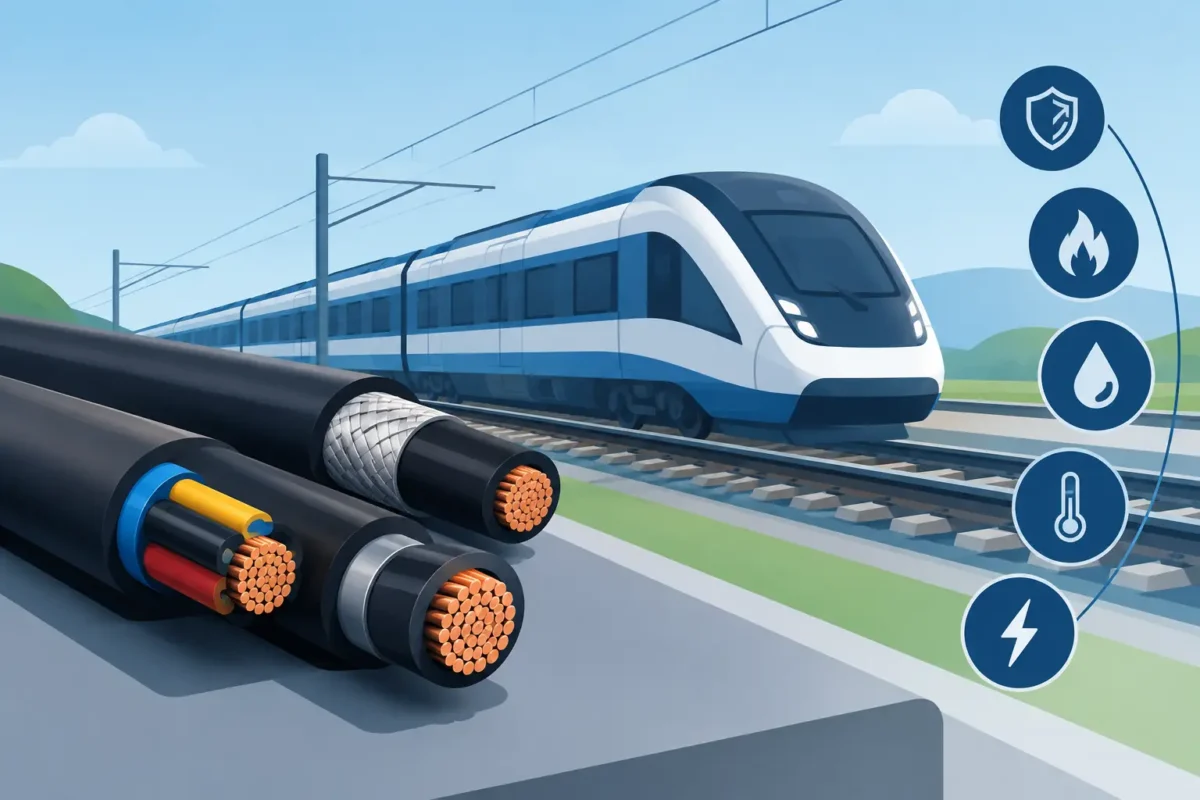
Understand the key railway cable requirements and specify safe, durable, and reliable solutions for critical railway operations in the field.
A cable failure in a train, signaling system, or railway substation represents more than just a maintenance stoppage. It can disrupt service, compromise communication between systems, increase the risk of fire, and generate significant downtime costs. Therefore, the main railway cable requirements should be evaluated from the basic engineering stage, not just during the procurement phase.
The correct specification depends on the installation point, the electrical function, and the risk profile of the application. A cable for internal rolling stock interconnection faces vibration, bending, and severe fire resistance requirements. A cable for external signaling, on the other hand, needs to withstand moisture, solar radiation, abrasion, and, in many cases, electromagnetic interference. Treating these applications as equivalent is a recurring source of premature failures.
Key railway requirements for critical cables
In the railway sector, the cable needs to be analyzed as part of the functional safety and availability of the system. Conductor, insulation, shielding, sheathing, and identification must work in an integrated way to maintain electrical and mechanical performance throughout its expected service life.
Fire safety and low smoke emission.
In tunnels, stations, passenger cars, and confined technical areas, fire performance is a central requirement. It's not enough to simply verify that the material is flame retardant. The specification must consider flame propagation, smoke emission, acidity, and corrosiveness of the gases generated during combustion.
The EN 45545 family of standards is a frequent reference for fire protection in railway applications. It classifies materials according to risk levels, typically identified as HL1, HL2, and HL3, and relates each application to specific sets of requirements. For cables, the selection may involve requirements such as R15, but the applicable classification varies depending on the type of vehicle, the installation area, and the design.
Tests such as IEC 60332 for flame propagation, IEC 60754 for halogenated gases and acidity, and IEC 61034 for smoke density are usually part of this analysis. Halogen-free cables can reduce the emission of corrosive and toxic gases, but this characteristic alone does not prove compliance with the set of railway requirements. It is necessary to validate the construction, materials, and test results required by the contract.
Mechanical resistance under vibration, bending and abrasion.
Rolling stock subjects cables to continuous vibrations, relative movements between components, and installation stresses in confined spaces. In doors, bogies, auxiliary systems, harnesses, and mobile connections , the minimum bending radius and bending strength cease to be catalog details and become key factors in defining the durability of the circuit.
The construction must consider the conductor stranding class, insulation thickness and composition, sheath strength, and, where applicable, reinforcing elements. An excessively rigid cable can hinder assembly and concentrate stress on the terminals. A very flexible cable, without materials suitable for the environment, may suffer accelerated wear due to friction or crushing.
For exposed areas, the covering must also withstand impact, abrasion, oils, greases, cleaning products, and contaminants found in workshops and yards. Special elastomeric or thermoplastic compounds may be suitable, but the choice depends on temperature, chemical exposure, desired lifespan, and movement dynamics.
Temperature, weathering and environmental resistance
The railway environment presents extremes: heat near power equipment, low temperatures on specific routes, condensation, metallic dust, pressure washing, and solar radiation. The cable's thermal capacity must be compatible with its operating voltage, current, grouping, ventilation, and actual ambient temperature.
In outdoor installations, resistance to UV, ozone, and humidity is crucial. Inadequate coating can harden, crack, or lose dielectric properties before the end of its design life. In boxes, ducts, and underground passages, the concern shifts to infiltration, eventual flooding, chemical attack from the soil, and tensile strength during installation.
There are also situations where the presence of rodents, industrial fluids, or saline atmospheres requires additional solutions. The correct requirement is not the most severe in all cases, but rather the one that responds to the actual operating conditions without generating technical and financial oversizing.
Electrical performance and signal integrity
In railways, power, control, data, communication, and signaling cables can coexist in cable trays, cabinets, and infrastructure routes. This proximity demands attention to electromagnetic compatibility. Induced noise in low-voltage circuits can affect telemetry, control, detection, and communication, especially when frequency inverters, traction motors, and power equipment are in the same environment.
For sensitive circuits, shielding must be defined according to the frequency, interference level, and intended grounding method. Tape shielding, copper braiding, or combined solutions exhibit different behaviors. The electrical continuity of the shielding, including at terminations and connections, is as relevant as its presence in the cable construction.
Physical segregation of routes is also part of the solution. A shielded cable alone does not correct an installation that improperly approximates power and signal or uses grounding without proper criteria. Engineering must evaluate impedance, capacitance, conductor resistance, voltage drop, short-circuit current, and transmission requirements for each circuit.
Voltage, current, and fault behavior
The selection of the nominal cross-section cannot be limited to the steady-state current. It is necessary to consider derating by grouping, ambient temperature, type of installation, and ventilation. In power circuits, the ability to withstand thermal and electrodynamic stresses during a short circuit can be decisive.
In systems that need to continue operating during a fire event, fire-resistant cables may be necessary. However, fire resistance and low smoke emission are distinct properties. The circuit maintainability requirement must be explicitly stated in the design, including survival time, fastening method, and test conditions. An inadequately supported installation may fail even when using a technically appropriate cable.
Standards, documentation and traceability
The applicable standards vary depending on the scope. EN 50264 is widely associated with power and control cables for rolling stock, while EN 50305 deals with test methods for railway cables. IEC specifications, operator requirements, OEM standards, design documents, and Brazilian standards eventually cited in the project should also be included in the compliance matrix.
The critical point is to avoid the generic designation of "railway cable." This description does not provide information on fire hazard level, thermal range, voltage, shielding, flexibility, chemical resistance, or installation conditions. A complete technical specification must establish the application, nominal voltage, number and cross-section of conductors, construction, insulation and sheathing material, fire requirements, environmental tests, reference standard, marking, and acceptance documents.
Certificates, test reports, technical data sheets, inspection plans, and batch traceability reduce uncertainties during receiving and maintenance. In long-term projects, standardization also facilitates future replacements and prevents supplier changes from introducing constructions incompatible with the original installation.
How to transform requirements into a feasible specification.
The best specification begins with mapping the circuit and the environment. It is necessary to identify whether the cable will be embedded, installed on a track, in a station, in a tunnel, in a substation, or in a workshop; whether it will be fixed or mobile; and what consequences a failure could generate. Based on this diagnosis, the requirements for fire resistance, mechanical performance, electromagnetic compatibility, and environmental resistance gain technical priority.
It's also worth involving manufacturing and engineering before freezing the bill of materials. Special projects often require adjustments to shielding, vein coding, coating, colors, packaging dimensions, or documentation. This step avoids unfeasible specifications, incompatible deadlines, and last-minute substitutions that compromise approval.
Innovcable develops special cables based on real-world operating conditions, combining in-house manufacturing, quality control, and customized construction for critical industrial applications. In railway systems, this approach allows each requirement to be evaluated as part of the overall performance, and not as an isolated item in the technical specifications.
When cable selection is based on risk, environment, and the circuit it serves, installation becomes more predictable. This results in reduced unscheduled interventions, system protection, and the operational continuity that a railway requires every day.