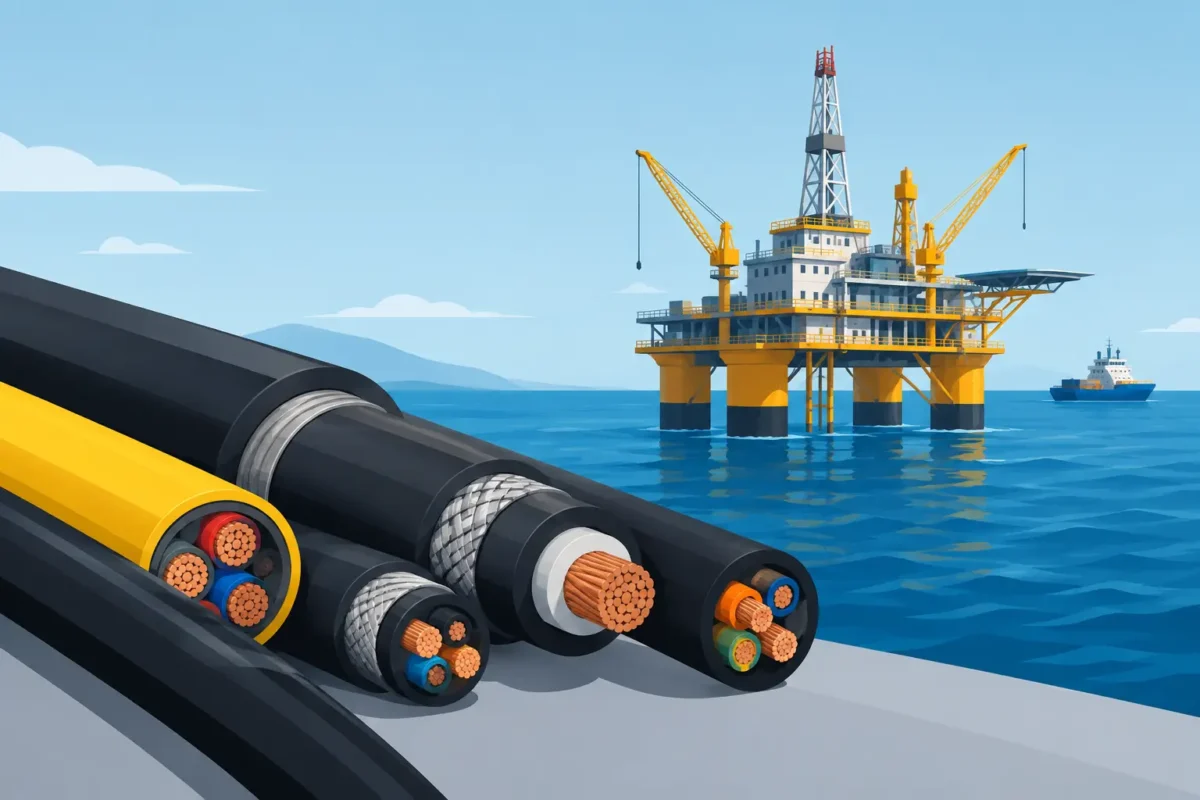
Understand which cable to use on offshore platforms and select solutions for power, control, and data with safety, standards, and critical environmental resistance.
On an offshore platform, the question is not just which cable to use , but which construction can withstand, for years, the combination of salt spray, hydrocarbons, vibration, structural movement, fire risk, and operational continuity requirements. A choice based solely on voltage, nominal cross-section, or price can lead to unscheduled shutdowns, communication failures, and significant risks to operational safety.
The specification must consider the complete circuit, the installation environment, the area classification, and the applicable design standard. In fixed units, FPSOs, support vessels, or offshore modules, the cable needs to meet the actual operating conditions, not just a generic catalog description.
Which cable to use on offshore platforms
There is no single cable suitable for all systems on a platform. Power, control, instrumentation, data, telecommunications, motor, and emergency systems cables have different requirements. The starting point is to separate the critical functions of the installation and define the expected performance level for each route.
For low-voltage power distribution, cables with insulation and sheathing made of thermosetting compounds, such as EPR, HEPR, or special rubber, are commonly used, selected according to voltage, service temperature, oil resistance, and flame requirements. In naval and offshore applications, constructions aligned with standards such as IEC 60092 and NEK 606 may be required by the project, the operator, or the classification society.
In control and instrumentation circuits, priority becomes signal integrity, shielding, and low electromagnetic interference. In industrial networks, automation, and data transmission, electrical performance must be preserved even in proximity to motors, frequency inverters, and power panels. Therefore, it is not advisable to treat signal cables as extensions of conventional electrical cables.
The choice also changes depending on whether the installation takes place in outdoor areas, electrical rooms, skids, machine rooms, walkways, process zones, or classified areas. Direct exposure to sunlight, seawater, frequent washing, oil, chemicals, and mechanical impact alters the required specification.
The offshore environment defines the cable construction.
The marine atmosphere accelerates degradation processes. Salt deposited on surfaces, constant humidity, and thermal cycles can compromise inadequate coatings and promote damage that is not initially visible. Therefore, resistance to water, ozone, UV radiation, abrasion, and industrial fluids must be evaluated according to the installation route.
In exposed areas, a high-performance rubber or elastomeric compound sheath can offer better mechanical and environmental performance than materials intended for conventional indoor installations. This does not eliminate the need to check bending, fastening, mechanical protection, and termination method. A technically correct cable can fail prematurely if it is crimped, stretched beyond its limit, or installed without adequate strain relief.
When there is a possibility of damage from impact, crushing, or mechanical attack, reinforcement may be necessary . However, the reinforcement solution should not be applied automatically. It increases weight, diameter, cost, and installation effort. Furthermore, the compatibility of the reinforcement with grounding systems, cable glands, and classified area requirements needs to be defined in the design.
In sections subject to continuous movement, such as lifting equipment, mobile systems, embedded robotics, or connections that experience intense vibration, flexibility becomes crucial. In these cases, conductors with appropriate stranding, reinforcing elements, and bend-resistant coverings are more relevant than a rigid construction for static use.
Fire safety requires technical distinctions.
On a platform, flame spread, smoke emission, and circuit survival during a fire are different criteria. Confusing them leads to incomplete specifications.
A flame-retardant cable aims to limit the spread of fire along the bundle. A cable with low smoke and acid gas emissions, often associated with halogen-free compounds, helps reduce the opacity and corrosiveness of gases generated in an incident. A fire-resistant cable, on the other hand, is designed to maintain circuit operation for a period and under conditions defined in testing, something essential for certain emergency loads, detection, alarm, fire fighting, evacuation lighting, and critical communication.
A halogen-free material is not automatically fire-resistant. Similarly, a fire-resistant cable may require specific construction, compatible accessories, and a protected route for the system to deliver the expected performance. The analysis should consider the cable, fasteners, cable trays, boxes, cable glands, and the required operating time for each circuit.
Power, control, and data should not be treated as the same solution.
Proper circuit segregation is a measure of reliability. Power cables can produce electromagnetic fields that affect low-voltage signals, analog instrumentation, and industrial communication. Proximity to variable-speed drives requires even greater attention.
For motors powered by frequency inverters, cables specifically designed for VFDs or servomotors help control the effects of fast pulses, reflected voltage, common-mode currents, and interference. Shielding, construction geometry, and proper grounding are all part of performance. Choosing cables solely based on motor current ignores factors that can reduce insulation lifespan and damage connected equipment.
In instrumentation, twisted and shielded pairs are recommended when the process requires stable signals over long distances or in electromagnetically noisy environments. Shielding can be individual, collective, or combined, depending on the sensitivity of the signals and the system architecture. The grounding point must follow the engineering philosophy of the installation, as improperly connected shielding can introduce noise instead of reducing it.
For data networks, it is necessary to confirm the protocol, category, impedance, transmission rate, minimum bending radius, and environmental compatibility. In platforms, the communication cable needs to be specified both for network performance and for the mechanical and chemical resistance that its route requires.
How to specify the cable safely
Before requesting a quote or authorizing a purchase, gather the data that defines the application. Rated voltage, current, permissible voltage drop, and cross-section are essential, but not sufficient. Ambient and conductor temperature, installation method, wiring configuration, circuit length, exposure to oil and chemicals, shielding requirements, flexibility class, fire hazard, and applicable standards should also be included.
The area classification deserves specific treatment. In areas with a risk of explosive atmospheres, the entry and termination components are as relevant as the cable itself. Cable glands, boxes, sealing, electrical continuity of the armor, and degree of protection must be compatible with the adopted protection concept. It should not be assumed that a cable suitable for a marine environment is, by itself, suitable for any classified area.
It is also necessary to validate technical documents. Data sheets, descriptive reports, single-line diagrams, cable lists, classification society requirements, and operator specifications may establish criteria that go beyond general standards. In retrofit projects, it is worthwhile to inspect existing routes, available space in cable trays, bending radii, and interfaces with already installed accessories.
On-demand manufacturing is especially valuable when the project requires an unconventional combination of voltage, number of conductors, shielded pairs, armor, special sheathing, identification, and regulatory compliance. Innovcable operates in this type of development with applied engineering, allowing the cable construction to be aligned with the actual operating conditions and project documentation.
Mistakes that shorten the lifespan in the field.
A common mistake is to substitute a naval or offshore cable with a commercial building cable, considering only the same cross-section and voltage. Electrical equivalence does not mean equivalence in environmental, mechanical, or safety performance.
Another critical point is using standard flexible cable where there is continuous bending. Flexibility for assembly is not the same as capacity for millions of cycles. In dynamic applications, the cable needs to be designed for the expected movement, speed, acceleration, path, and tensile stress.
Finally, the installation must preserve the integrity of the solution. A bending radius below the recommended value, excessive tightening of clamps, incorrect crimping, splices without adequate protection, and poor grounding of shields or armor reduce reliability even when the product has been properly specified.
The best decision is to treat each cable as an active part of the platform's security and availability. When the requirement is clear, engineering stops simply buying meters of cable and starts selecting a solution capable of supporting operations where failure is not an option.