Learn when to use industrial shielded cable to reduce interference, preserve signals, and specify critical installations with safety and performance.
Intermittent instability in a control loop, fluctuating transmitter readings, or communication failures near an inverter are rarely problems that can be solved simply by replacing components. In these scenarios, understanding when to use shielded industrial cable is a crucial part of installation engineering. Shielding helps control electromagnetic interference, but it only delivers results when the cable, assembly, and grounding are specified as a system.
The indiscriminate use of shielded cables increases cost, weight, outer diameter, and termination complexity without necessarily improving performance. On the other hand, saving money on specifications in sensitive circuits can lead to downtime, lengthy diagnostics, and loss of reliability. The correct decision begins with an analysis of the electrical environment, the type of signal, and the consequences of a failure.
When to use industrial shielded cable in critical applications
Shielded cable should be considered when there is a significant risk of electrical or electromagnetic noise coupling to the circuit. This occurs, for example, in routes shared with power cables, motor drives, contactors, switched-mode power supplies, electric welding, radio frequency systems, and panels with a high density of electronic equipment.
In instrumentation, low-amplitude signals are especially vulnerable. Thermocouple circuits, load cells, encoders, transmitters, proportional valves, and analog signals can suffer distortions even when the system power supply appears normal. A small interference in the cable can be enough to alter a measurement, cause improper actuation, or compromise the quality of a process.
It is also common to specify shielding in industrial networks, servomotor controls, feedback circuits, and communication between automation equipment. In these cases, the goal is not only to avoid reading errors, but also to preserve data integrity, movement repeatability, communication stability, and machine availability.
Cables for frequency inverters require particular attention. The rapid switching of these devices generates high-frequency components that can radiate or conduct interference to nearby circuits. The appropriate cable, with shielding and construction compatible with the application, contributes to the control of electromagnetic emissions and to the protection of the motor assembly, inverter, and automation system.
What does armor protect against and what does it not solve?
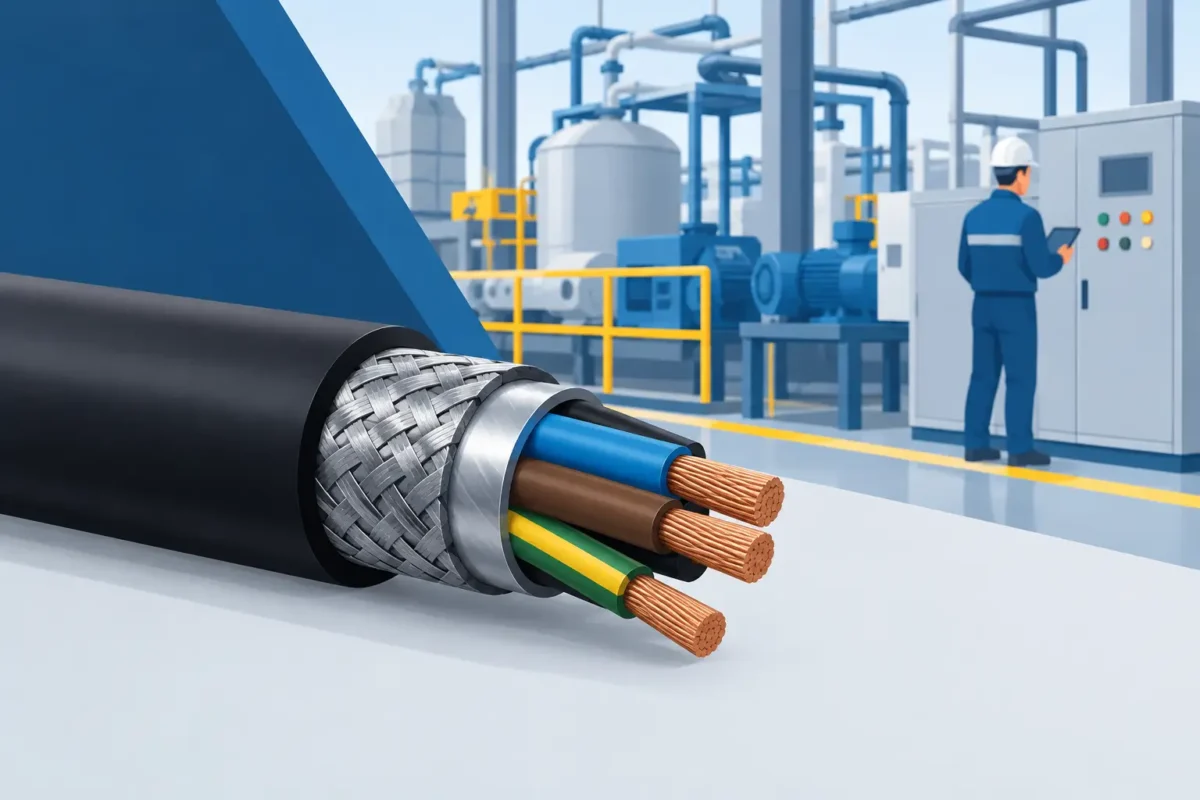
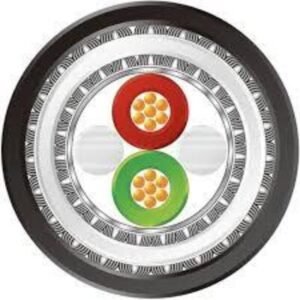
Shielding is a conductive layer applied over conductors or signal pairs. It can be made of metallic tape, copper braid, a combination of tape and braid, or other elements defined according to the application. Its function is to create a preferential path for interfering currents and fields, reducing noise coupling to the internal conductors.
Efficiency depends on the frequency and type of interference. Tape shielding can offer good electrostatic protection, while braided shielding with adequate coverage tends to have relevant performance against electromagnetic interference, in addition to greater mechanical strength. In severe applications, the construction may include individual shielding per pair and collective shielding, a useful solution to reduce crosstalk between signals and external interference.
However, shielding does not correct all problems. It does not compensate for undersized conductors, insulation incompatible with temperature, inadequate choice of material for oil or chemical agents, nor installation with an incorrect bending radius. It also does not replace route segregation, properly executed functional grounding, and electromagnetic compatibility assessed in the design.
A shielded instrumentation cable installed in the same conduit as a power feeder, without distance, metallic separation, or routing criteria, may remain exposed to unacceptable levels of interference. Similarly, a broken or poorly connected shield can transform a technically correct solution into an additional source of noise.
Signs that indicate the need for shielding.
The decision should be based on application data, not just the assumption that the environment is industrial. Some practical signs help identify the need for a shielded cable:
- Unstable analog readings, especially when motors or inverters are activated;
- Intermittent communication failures in field networks or data interfaces;
- Loss of reference in encoders, servos, and positioning systems;
- Improper activation of digital inputs or alarms without apparent cause;
- Cable routes near power sources, electronic switches, transformers, or welding equipment.
These symptoms alone do not prove that the cable is the source of the problem. The investigation should consider grounding topology, connection quality, connector condition, physical separation between circuits, and equipment configuration parameters. Even so, they indicate that electromagnetic compatibility needs to be included in the scope of the analysis.
Shielding, grounding, and termination form a single requirement.
One of the most common mistakes in the field is treating the shielding as a drain wire connected haphazardly to ground. The connection needs to be defined according to the signal type, frequency range, grounding architecture, and equipment manufacturer recommendations. In high-frequency systems, for example, a 360-degree contact termination on the shielding is usually more efficient than a long pigtail connection, which adds inductance to the circuit.
The connection of the shielding at one or both ends does not allow for a universal answer. Grounding at a single point may be adequate in certain low-frequency applications and where there is a risk of potential differences between masses. Grounding at both ends may be necessary for better performance against high-frequency interference, provided that the equipotential bonding of the installation is adequate.
The criteria must be documented in engineering. When the decision is left to field assembly, variations arise between panels, machines, and installation shifts. The result is a system that is difficult to commission and even more difficult to maintain. Standardizing connectors, cable glands, shielding clamps, and equipotential bonding points reduces this risk.
Not all shielded cables are the same.
The specification needs to go beyond the term "shielded cable." For a control , instrumentation, data, servomotor, or inverter cable, the internal construction must meet the actual operating conditions. Number of conductors, pair or triple formation, nominal cross-section, flexibility class, insulation material, service voltage, shielding covering, and outer sheath directly influence performance.
In a cable carrier system , continuous bending requires specific mechanical construction. In marine, oil and gas, or mining environments, resistance to oil, abrasion, moisture, flame, vibration, and chemical agents can be as important as electromagnetic protection. In outdoor areas, solar radiation and temperature variations come into play. A shielded cable with an inadequate sheath will still be a point of failure, even if its electrical response is correct.
It is also necessary to assess contractual norms, safety requirements, and standards applicable to the project. Compliance may involve national specifications, IEC, OEM requirements, or industry standards. Technical documentation must clearly state the expected performance and acceptance criteria, especially in critical infrastructure projects and plants with high traceability requirements.
How to specify the solution without oversizing it.
The best specification balances performance, durability, ease of installation, and total cost of ownership. Start by mapping the sources of interference and physical routes. Then, classify the circuits by sensitivity: power, control, analog signal, communication, feedback, and safety should not receive the same treatment just because they are in the same equipment.
Next, define the cable construction based on the application. A shielded pair may be sufficient for a specific signal. In another case, a combination of individually shielded pairs with collective shielding will be more suitable. For servomotors and inverters, the complete assembly must be evaluated, including power conductors, grounding elements, shielding, connectivity, and termination practices.
Finally, validate the installation before startup. Visual inspection, shielding continuity, connector integrity, route segregation, and grounding verification should be part of the commissioning process. In critical processes, measuring and recording these criteria prevents system reliability from depending on individual interpretations in the field.
Innovcable develops solutions for demanding industrial applications because each environment imposes its own combination of mechanical stress, interference, standards, and operating timeframes. When the specification is treated as applied engineering, the cable ceases to be a purchase item and becomes essential for protecting the continuity of the process it connects.