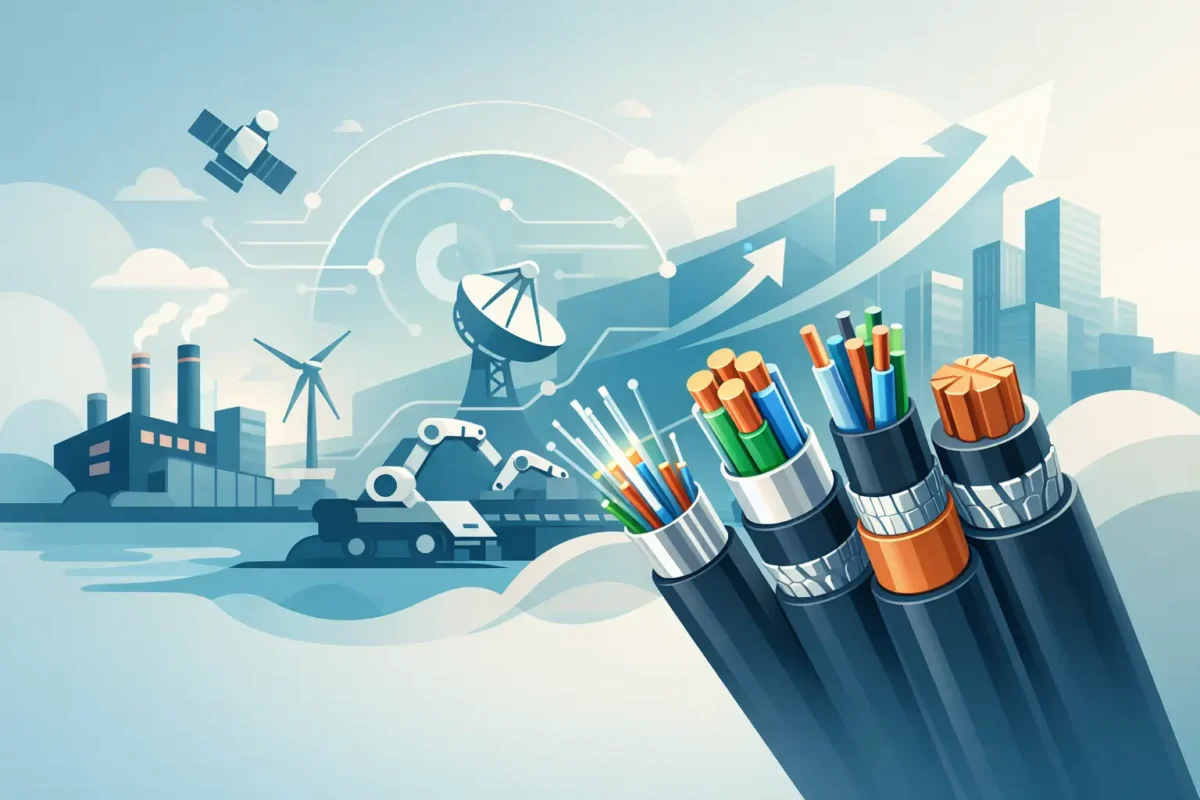
Trends in industrial cabling combine automation, data, safety, and durability. Learn how to specify solutions for critical field environments.
A stoppage on an automated conveyor belt, an intermittent failure in the instrumentation signal, or overheating of an inverter circuit are not isolated installation problems. In many cases, they are consequences of a cable specification that did not match the application. Trends in industrial cables point precisely to this: the cable has ceased to be a component defined only by nominal cross-section and voltage, becoming an active part of operational reliability.
For OEMs, integrators, EPC contractors, and maintenance teams, the change is clear. There is a growing demand for cables that transmit power, data, and signals stably under conditions of movement, electromagnetic interference, oil, humidity, abrasion, heat, and continuous duty cycles. The right decision depends less on adopting a generic solution and more on translating the real project conditions into electrical, mechanical, and regulatory requirements.
Trends in industrial cables that guide new projects.
Automation with higher motion density
The expansion of industrial automation has increased the demand for cables for robotics, cable carriers, lifting systems, and mobile equipment . In these areas, flexibility alone does not guarantee performance. Cable behavior is determined by the conductor construction, stranding, reinforcement elements, internal geometry, shielding, and insulation and sheathing materials.
On a conveyor belt, for example, the radius of curvature, acceleration, travel, speed, and predicted number of cycles need to be included in the specification. An inadequate cable can exhibit broken cores, displacement of the internal assembly, premature wear of the sheath, or variations in signal transmission. In robotics, twisting movements add another critical variable: the cable must withstand the dynamics of the arm without transferring excessive stress to the conductors.
The trend is to design for the expected lifespan of the machine, not just for initial bench approval. This may increase the initial investment, but it reduces unscheduled interventions, material waste, and asset downtime. In applications with low motion frequency, a simpler design may suffice. The point is not to apply the same cable to scenarios with completely different mechanical demands.
Greater attention to electromagnetic compatibility
Frequency inverters, servomotors, industrial networks, and instrumentation systems coexist in increasingly dense panels and routes. This reality amplifies concerns about electromagnetic interference , eddy currents, and signal quality degradation.
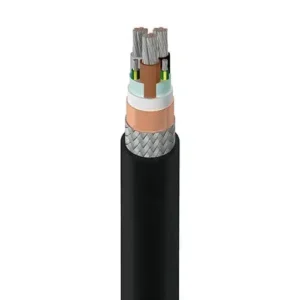
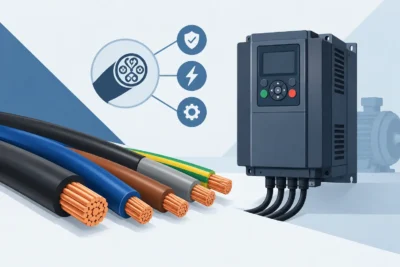
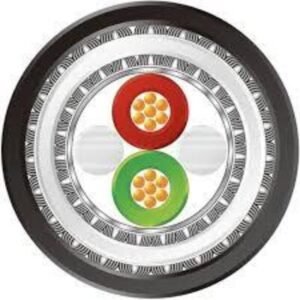
Cables for inverters and servomotors require special attention to shielding, capacitance, and system grounding. The high-frequency switching of inverters can generate voltage spikes and noise that affect not only the motor but also nearby equipment. Poorly defined shielding, discontinued during installation, or shielding incompatible with the application does not completely solve the problem.
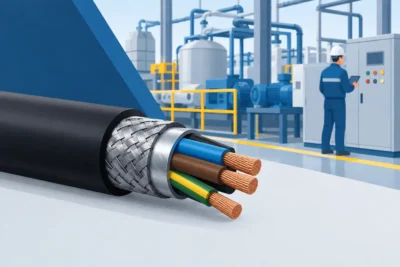
In control and instrumentation circuits, pair separation, individual or collective shielding, and correct conductor identification contribute to preserving low-intensity signals. However, there is no single solution. The interference level, circuit length, grounding topology, proximity of power cables, and communication protocol should guide the choice. Specifying more shielding without evaluating the overall system can increase costs and complicate assembly without generating proportional gains.
Fire safety and business continuity
In naval, oil and gas, mining, airport infrastructure, tunnels, and areas with high concentrations of people, cable behavior in case of fire is an engineering criterion. The concern is not limited to flame propagation. Low smoke emission, reduced release of corrosive gases, and maintenance of essential circuits can be crucial for the safety of people and for operational response.
The selection should consider the function of that circuit during an incident. Alarm systems , detection, emergency lighting, communication, and control of critical equipment may require cables with specific fire resistance characteristics. It is also necessary to verify which standards, test methods, and project requirements are applicable. Generic terms such as "flame-retardant cable" do not replace a technical analysis of the required condition.
This trend reinforces the need for consistent documentation. Certificates, test reports, raw material traceability, and quality control should accompany the solution, especially in projects subject to inspections, audits, or stringent contractual requirements.
Materials designed for real-world use.
The outer sheath is the cable's first barrier against environmental agents, but it should not be chosen solely based on appearance or thickness. Mineral oils, greases, hydrocarbons, saltwater, ozone, solar radiation, abrasion, and temperature variations all require compounds with distinct behaviors.
Rubber cables, for example, are frequently adopted in mobile and harsh-duty services due to their flexibility and mechanical resistance. Conversely, the choice of compound needs to be compatible with the chemical and thermal exposure of the operation. In outdoor areas, photovoltaic applications, and beacon systems, resistance to UV rays and weathering becomes important. In naval environments, in addition to humidity and salt spray, sector-specific standards may define specific construction and performance requirements.
The pursuit of greater durability also encourages the nationalization of solutions and on-demand development. When the cable is adapted to the environment, the installation route, and the project standard, the dependence on improvised adaptations in the field is reduced. The gain is not only in resistance: there is more predictability of replacement, standardization, and technical support throughout the life cycle.
How to transform trends into an applicable specification.
Effective specification begins with understanding the application, not by looking at the code of a similar product used in another project. The first step is to identify whether the cable transmits power, signal, data, or a combination of these functions. Next, it's necessary to map voltage, current, temperature, installation method, circuit length, shielding requirements, fire hazards, and exposure to chemical or mechanical agents.
In dynamic equipment, additional factors come into play such as radius of curvature, speed, acceleration, stroke, torsion, and estimated number of cycles. In power systems, it is worth evaluating voltage drop, current carrying capacity, short circuits, harmonics, and effects associated with inverters. For data and instrumentation applications, impedance, capacitance, shielding, and signal integrity should be treated as performance requirements, not as secondary details.
The applicable standard is not a fill-in item.
National standards, IEC, NEK-606, and American standards can coexist in the same project, especially when there is imported equipment, international contracts, or specific end-customer requirements. Compliance needs to be assessed from the engineering phase, considering both the cable and the documentary and installation acceptance criteria.
It is common to find projects where the nominal voltage is correct, but the construction does not meet the environmental, bending class, or fire performance requirements. The opposite also occurs: a technically superior solution is selected, but becomes unfeasible due to time, availability, or cost without an evaluation of equivalent alternatives. Engineering must balance criticality, operational risk, compliance, and feasibility of supply.
Customization should address a measurable need.
Special projects justify customization when there is a condition that a standard item does not adequately meet: unusual conductor combinations, reinforced shielding, material for harsh environments, specific identification, manufacturing length, low smoke requirement, or high flexibility. Customizing without criteria can create inventory and maintenance complexity. Customizing based on application data generates useful standardization.
A manufacturer with applied engineering expertise can support this definition by analyzing the construction design, materials, and tests relevant to the demand. At Innovcable, this work is connected to in-house manufacturing, the development of special solutions, and quality control at critical points in the process. For the technical buyer, the expected result is clear: a cable that meets the promised performance, is traceable, and can be reproduced in future replacements.
What changes in industrial purchasing decisions?
Purchasing based solely on price per meter tends to ignore the most significant cost: operational failure. In critical assets, a lower-cost cable may require premature replacement, paralyze a line, compromise a measurement, or increase exposure to safety risks. On the other hand, specifying the most complex solution available for all points is also not efficient.
The best decision considers criticality, installation conditions, maintenance frequency, and the impact of a potential failure. Fixed cables in a controlled environment require a different analysis than that applied to a lifting system, an offshore route, a robotic arm, or an emergency circuit. The most valuable trend is not simply adopting new technologies. It is raising the quality of the specification so that the cable performs exactly the function that the process requires, for the time that the operation needs.